Everest View Trek 11 days
Trip Facts
 Duration
11
Duration
11
 Trip Grade
Easy
Trip Grade
Easy
 Country
Nepal
Country
Nepal
 Maximum Altitude
3,860 meters (12,664 feet)
Maximum Altitude
3,860 meters (12,664 feet)
 Group Size
2-16 People
Group Size
2-16 People
 Starts
Lukla
Starts
Lukla
 Ends
Lukla
Ends
Lukla
 Activities
Trekking Sightseeing
Activities
Trekking Sightseeing
 Best Time
Sep.Oct.Nov.Dec.March.April.May
Best Time
Sep.Oct.Nov.Dec.March.April.May
Overview
Everest view trekking is the Everest Short trek especially designed for all those trekking enthusiasts who are short on time but do not want to miss the opportunity to devour the close-up views of the world’s highest peak – Mt.Everest. The interesting part of this trek is that even the senior citizens and children can successfully do this trek. This is an abridged version of the Everest Base Camp Trek with focus only on the views from the relatively lower part of Nepal. Also known as Everest Panorama View Trek, you shall be trekking through the dense forest full with rhododendrons, crossing rivers via several suspension bridges, passing the settlements of Sherpas, and enjoying the spiritual inclination of these people. No other trekking package can offer you the best views of Everest in such a short time, with a complete blend of little adventure, scenic landscapes, staggering views of the Everest Base Camp, and some cultural exploration.
Route
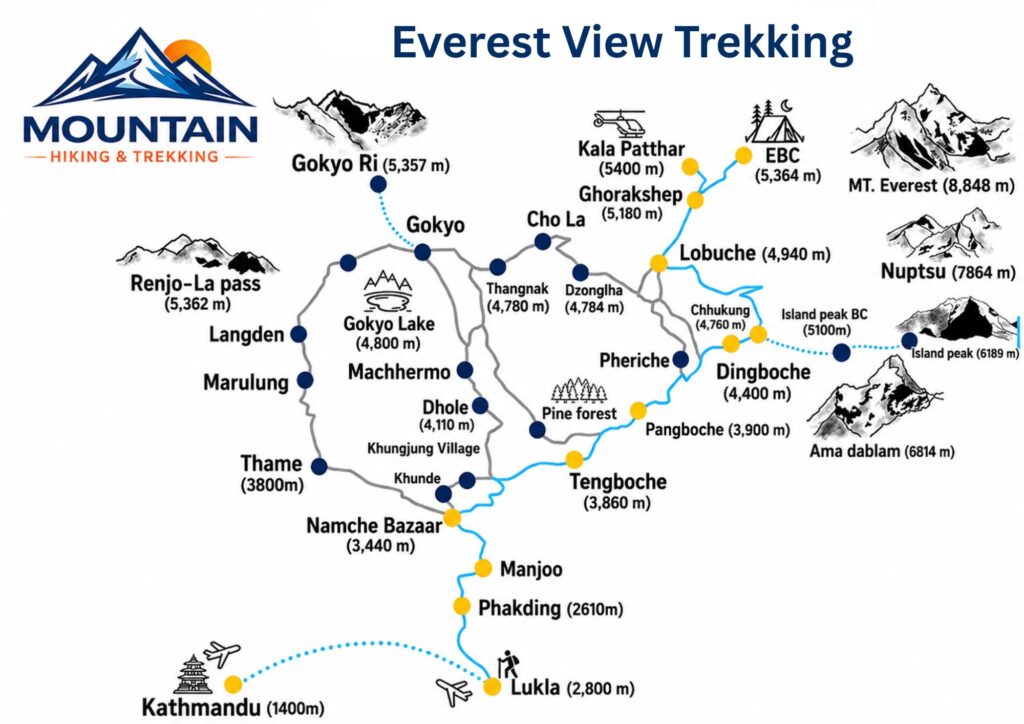
Kathmandu (1,345 m)- Lukla (2,860 m)- Phakding (2,610 m)- Namche Bazar (2,330 m)- Thyangboche (3,860 m)- Monju (2,800 m)- Lukla (2,860 m) – Kathmandu (1,345 m)
Food and Accommodation
Throughout the trek, you shall be served with local dishes at several teahouses and hotels. You shall be served with pancake, toast, oats, eggs, etc. with tea or coffee for breakfast. You can get spaghetti, Macaroni, noodles, Dal Bhat, etc. for lunch. It is better to have Dal Bhat during this trek. This dish is served with rice, lentils, green vegetables, different varieties of vegetables, meat, Papad, pickles made locally and salad. The interesting part of this dish is that you can ask for extra rice etc. within the same charge; you shall not be charged for additional servings. Ideally, this dish is supposed to be served at the same cost until you get filled. It is often said “Dal Bhat Power 24 Hour”, which is practically true. However, you can also get some international dishes, in limited varieties.
Difficulty
Unlike other treks in the Everest region, you have to walk for 4-5 hours every day during Everest View Trek. The altitude deviates from 1,345 m (at Kathmandu) to 3,860 (at Thyangboche) throughout the trek. There is less chance of altitude sickness. None of the trails are strenuous. Due to these reasons, Everest View Trekking is the perfect trekking package for senior citizens, children, and people who cannot trek too long and cannot adapt in high altitude areas. If you have some prior trekking experience and have been doing exercises regularly, they shall be added advantages for successfully completing this trek; though they aren’t mandatory. These let your body become familiar with high altitude and make you adapt easily while there’s less content of oxygen in the air. Since this is an easy trek limited to the lower altitude regions in the Everest region, you shall not face any challenge or any difficulty to complete this trek.
Best time to travel
September to October and March to May are considered the perfect times to do any trek in Nepal, including the Everest View Trek. During September to October, the lower altitude areas aren’t too hot, whereas the high altitude areas, though you won’t be trekking at much high altitude, remain moderate—not too cold. However, the early morning and night can be quite chilly and cold. However, during March to May, the lower region remains quite hot, but the higher region stays moderate. There might be some possibility of rainfall. October is the busiest time of the year. And you shall find lots of trekkers and climbers during this season trekking in this region. Perhaps, despite your preference, this is also the best time to do this trek.
Why Mountain Hiking & Trekking Pvt. Ltd.?
Mountain Hiking & Trekking Pvt. Ltd. is a leading Best travel and trekking agency in Nepal taking trekkers from around the world to several trekking destinations in Nepal, safely and within the scheduled time frame. We are a group of experienced, proactive, dynamic, dedicated and committed professionals serving trekkers for years. We have been trusted by trekkers from different parts of the world, and have been maintaining the record of successful completion of every trek we have served so far. We have proper coordination with best English speaking local guides and honest porters. We can customize the trek as per your needs and preferences. If you want to spend some more time in a place, do let us know, we shall ensure that our itinerary lets you grab most out of this trek. Also let us know who the potential trekkers are so that we can ensure that the required physical and other requirements are available throughout the trek, and book or reserve the availability ahead of time. For more information about this trek, or our services, do not hesitate to contact us; we shall be pleased to hear from you.
Tour Highlights
Enjoy a scenic Everest View Trek with stunning views of Mount Everest, Lhotse, Nuptse, and Ama Dablam. Visit the peaceful Tengboche Monastery, explore the vibrant Sherpa town of Namche Bazaar, and experience rich Sherpa culture along the trail. Walk through beautiful forests and landscapes, stay in cozy teahouses, and enjoy a scenic flight to Lukla, making this trek a perfect mix of nature, culture, and comfort at a moderate altitude.
- Stunning views of Mount Everest and surrounding peaks
- Visit Tengboche Monastery
- Explore Namche Bazaar u2013 Sherpa hub
- Experience Sherpa culture and local villages
- Walk through rhododendron forests and scenic landscapes
- Optional panoramic flight to Lukla Moderate altitude trek (suitable for beginners)
- Stay in traditional teahouses with local hospitality
Why Travel With Us
Travel with us for a safe, smooth, and unforgettable trekking experience in Nepal. We offer 24/7 customer support and prioritize your safety with advanced medical and rescue equipment on every trek. As a certified operator under the Nepal Tourism Board, Trekking Agencies' Association of Nepal, and Nepal Mountaineering Association, we ensure trusted and professional service. With no hidden fees, free airport transfers, cultural experiences like Nepali & Sherpa cooking classes, and live updates for your loved ones, we make your journey comfortable, authentic, and memorable.
- 24/7 customer support
- Strong safety system with full emergency equipment
- Certified and trusted tour operator (NTB, TAAN, NMA)
- No hidden charges or extra fees
- Free airport pick-up and drop-off
- All taxes and permits included Free Nepali & Sherpa cooking classes Social media updates during trek
- Experienced local Sherpa guides
- Focus on safety, culture, and comfort
Everest View Trekking Itinerary
Day 1: Arrive Day in Kathmandu (1,400m / 4,593ft) Hotel Lo Mustang 4 star with bed & Breakfast

 Accommodation: Hotel Lo Mustang 4 star
Arrival In Nepal Airport 1350 mtrs.
Well Come To Himalayas Nepal! We Pick Up You From Tribhuvan Intenational Airport And Drop You To Your Hotel That we Have Booked. After Resting Some Hours We Will Meet To Brief You About Our Program.
Ovenight at the hotel.
Meals: Breakfast and welcome Dinner
Day 2: Full day city Tour in Kathmandu4 place 5-6 hrs. overnight at Hotel Lo mustang 4 star
Accommodation: Hotel Lo Mustang 4 star
Duration: Approximately 5-6 hoursnn1. Breakfast: Start your day with a hearty breakfast at your hotel or a local cafu00e9 to fuel up for the day ahead.nn2. Swayambhunath Stupa (Monkey Temple):
Begin your tour by visiting Swayambhunath Stupa, one of the most iconic and ancient religious sites in Kathmandu.
Explore the stupa's complex, which includes shrines, temples, and a large stupa adoned with prayer flags and colorful decorations.
Enjoy panoramic views of the city from the hilltop location.nn3. Patan Durbar Square:
Head to Patan Durbar Square, located in the city of Lalitpur (Patan), which is known for its well-preserved Newar architecture.
Explore the various temples, palaces, courtyards, and intricate stone carvings that reflect the artistic and architectural heritage of the area.nn4. Lunch: Enjoy a traditional Nepali lunch at a local restaurant. This is a great opportunity to savor some local cuisine.nn5. Pashupatinath Temple:
After lunch, visit Pashupatinath Temple, one of the most sacred Hindu temples in Nepal and a UNESCO World Heritage Site.
Observe the temple's stunning architecture, and if you're respectful, you can witness Hindu cremation rituals along the Bagmati River.nn6. Boudhanath Stupa:
Proceed to Boudhanath Stupa, one of the largest stupas in Nepal and a significant pilgrimage site for Buddhists.
Take a leisurely walk around the stupa, spinning prayer wheels and observing the serene atmosphere.nn7. Thamel Shopping and Rest Break:
Thamel is a vibrant neighborhood known for its shopping and dining options.
Take a break to relax, do some shopping for souvenirs, or enjoy a cup of Nepali tea or coffee.nn8. Kathmandu Durbar Square:
End your day at Kathmandu Durbar Square, another UNESCO World Heritage Site.
Explore the historic square, admire the intricately carved wooden architecture of the old palace, temples, and statues.
Oveniht : At Hotel
Meals: Breakfast
Day 3: Fly to lukla 2,860 meters and trek to Phakding 2,610 meters (8,562 feet)
 Transportation: Flight and on foot
 Travel Duration: 35/40 mins flight + 3 to 4 hrs trek
Accommodation: Phakding best hotel
Travel Duration: 35/40 mins flight + 3 to 4 hrs trek
Accommodation: Phakding best hotel
 Activities: trekking
 Maximum Altitude: 2,860 meters / 9,383 feet
Moning Flight to Lukla:
Arrive at Tribhuvan Intenational Airport in Kathmandu.
Board an early moning flight to Lukla (2,860 meters / 9,383 feet).
Enjoy a scenic flight with breathtaking views of the Himalayas.
Landing in Lukla:
Land at Tenzing-Hillary Airport in Lukla, one of the most thrilling and challenging airports in the world.
Meet your trekking guide and begin preparations for the trek.
Start Trek to Phakding:
Begin the trek from Lukla, descending through beautiful villages and terraced fields.
Cross the Dudh Kosi River and follow the trail along its banks.
Pass through the village of Ghat and continue to Phakding (2,652 meters / 8,700 feet).
Lunch Break:
Stop for lunch in Phakding, enjoying local cuisine and taking a break.
The trek from Lukla to Phakding is approximately 8 kilometers and takes around 3-4 hours.
Aftenoon Exploration:
Explore Phakding and its surroundings in the aftenoon.
Visit the local monasteries or take a short hike for acclimatization.
Night in Phakding:
Check into a teahouse or lodge in Phakding for the night.
Rest and prepare for the trekking days ahead.
Ovenight at the Guest House
Meals: Breakfast, Lunch, and Dinner
Day 4: Trek To Namche Bazaar: 3,440 meters (11,286 feet ) Approximately 10.4 km. (6.5 miles)
Transportation: on foot
Travel Duration: 6-7 hours
Accommodation: Namche Bazaar best hotel
Activities: Trekking
Maximum Altitude: 3,440m / 11,286ft
Moning Departure:
Start your trek after breakfast, following the Dudh Kosi River.
Cross several suspension bridges, and enjoy views of waterfalls and pine forests.
Jorsalle Village:
Reach the village of Jorsalle for a lunch break.
Complete necessary entry formalities at the Sagarmatha National Park entrance.
Suspension Bridge and Ascent:
Cross another iconic suspension bridge and begin a challenging ascent to Namche Bazaar.
The trail offers panoramic views of Everest, Lhotse, and other surrounding peaks.
Namche Bazaar Arrival:
Arrive in Namche Bazaar, the vibrant and bustling Sherpa market town.
Check into a teahouse or lodge, and take some time to rest.
Acclimatization Hike:
In the late aftenoon, embark on a short acclimatization hike to the Everest View Hotel.
Enjoy stunning views of Everest and the surrounding peaks.
Explore Namche:
Spend the evening exploring Namche Bazaar.
Visit the local shops, bakeries, and the Sherpa Cultural Museum.
Night in Namche Bazaar:
Stay ovenight in Namche Bazaar, nestled in the heart of the Khumbu region.
Ovenight at the Guest House
Meals: Breakfast, Lunch, and Dinner
Day 5: Namche Bazaar - Rest and Acclimatize day
Transportation: on foot
Travel Duration: 3- 4 hrs
Accommodation: Namche Bazaar
Activities: Day Hiking & rest
Maximum Altitude: 3870
Spending a rest day in Namche Bazaar is a crucial part of acclimatization during the Everest Base Camp trek. It allows your body to gradually adapt to the increasing altitude and reduces the risk of altitude-related illnesses. Here's how you might spend your rest day in Namche Bazaar:
Acclimatization Activities:
Hike to Everest View Hotel: One of the popular acclimatization activities is to hike to the Everest View Hotel. This hike provides stunning panoramic views of Mount Everest, Lhotse, Ama Dablam, and other peaks. It's a relatively short hike from Namche Bazaar and offers an excellent opportunity to see the majestic mountains up close.
Explore Namche Bazaar: Take a leisurely stroll around Namche Bazaar to explore the town's markets, shops, and bakeries. You can shop for souvenirs, interact with the local Sherpa people, and enjoy the unique atmosphere of this vibrant mountain town.
Visit the Sagarmatha National Park Visitor Center: Spend some time at the visitor center to lean about the local culture, flora, fauna, and the challenges of the Everest region. It's an informative and educational experience that adds depth to your trek.
Rest and Relaxation: Utilize the day to rest, read, or simply relax. Catching up on sleep and allowing your body to recover is essential for a successful trek
Ovenight at the Guest House
Meals: Breakfast, Lunch, and Dinner
Day 6: Trek To Tyangboche (3,867 meters / 12,687 feet)
Travel Duration: 4-5 hrs
Accommodation: Tyangboche best tea house
Activities: Trekking & monastery visit
Maximum Altitude: 3870m/12,684ft 5-6 miles(8-10 km.)
Moning Departure:
Start your day with breakfast in Namche Bazaar.
Begin the trek, descending to the Dudh Kosi River before ascending towards Tengboche.
Kyajo Ri Viewpoint:
Along the trail, enjoy panoramic views of mountains like Ama Dablam and Kyajo Ri.
Take breaks to acclimatize and capture the stunning scenery.
Phunki Tenga:
Descend to the village of Phunki Tenga for lunch.
Cross the Dudh Kosi River and start the ascent towards Tengboche.
Tengboche Arrival:
Reach Tengboche, known for its picturesque location with the Tengboche Monastery against the backdrop of Ama Dablam.
Check into a teahouse or lodge, and take some time to rest.
Visit Tengboche Monastery:
In the late aftenoon, visit the famous Tengboche Monastery.
Explore the monastery grounds and enjoy the serene atmosphere.
Evening at Tengboche:
Spend the evening in Tengboche, surrounded by the beauty of the Himalayas.
Enjoy dinner with views of the snow-capped peaks.
Night in Tengboche:
Stay ovenight in Tengboche, immersed in the cultural and natural richness of the Khumbu region.
Ovenight at the Guest House
Meals: Breakfast, Lunch, and Dinner
Day 7: Trek from Tengboche to Monju (2,840 meters / 9,318 feet)
Travel Duration: 5-6 hrs.
Accommodation: Monju best tea house
Activities: Trekking
Maximum Altitude: 2,840 meters / 9,318 feet
Descent through Forests and Villages: The trail from Tengboche to Manju involves a descent through rhododendron and pine forests, with occasional clearings that provide beautiful views of the mountains. You'll likely pass through several small Sherpa villages along the way.
Namche Bazaar (3,440 meters / 11,286 feet): Depending on your specific itinerary, you may pass through Namche Bazaar on your way from Tengboche to Manju. Namche Bazaar is a significant trading hub and a popular acclimatization stop for trekkers heading to higher altitudes.
Downhill Sections and River Crossings: The trail will include downhill sections and several river crossings. Depending on the time of year and weather conditions, the rivers may be crossed using suspension bridges.
Manju (2,840 meters / 9,318 feet): Manju is a small settlement located on the trail to Everest Base Camp. It serves as a stopover for trekkers heading to higher altitudes or retuning from Everest Base Camp. The village is situated along the Dudh Koshi River.Ovenight at the Guest House Meals: Breakfast -lunch And Dinner
Day 8: Monjo to Lukla (2,860 meters / 9,383 feet)
Travel Duration: 4/5 hrs
Accommodation: Lukla
Maximum Altitude: 2,860 meters / 9,383 feet
The trek from Monjo to Lukla is a segment of the popular Everest Base Camp trek in the Khumbu region of Nepal. Here's a general overview of the trek from Monjo to Lukla:
Monjo (2,835 meters / 9,301 feet): Monjo is a small village located in the Sagarmatha National Park. Trekkers typically spend the night in Monjo, as it is a common stop on the way to and from Everest Base Camp. You'll have already obtained the necessary permits for the trek at this point.
Phakding (2,651 meters / 8,700 feet): While Phakding is not directly on the route from Monjo to Lukla, it's a nearby village that you might encounter depending on your specific trekking itinerary. If you haven't already stayed in Phakding, you might pass through on your way to Lukla.
Dudh Koshi River Crossings: The trail from Monjo to Lukla involves crossing the Dudh Koshi River multiple times. There are suspension bridges that offer passage across the river. These bridges can be exciting and provide stunning views of the river and surrounding landscapes.
Upward Sections: While the general trend is descending from Namche Bazaar to Lukla, there are some uphill sections as the trail undulates along the terrain.
Lukla (2,860 meters / 9,383 feet): Lukla is a significant town and the gateway to the Everest region. It is home to the Tenzing-Hillary Airport, one of the most challenging and adventurous airports in the world. Trekkers usually end their Everest Base Camp trek in Lukla before flying back to Kathmandu. Lukla offers various amenities, including accommodation, restaurants, and shops.nn nnOveniht At Guest House
Meals: Breakfast -lunch And Dinner
Day 9: Lukla - Kathmandu
Accommodation: Kathmandu
Maximum Altitude: 1350m/4428ft
After Breakfast fly back to kathamandu ones you arrived at domestic airport our airport guide will pick up you and drive to your hotel.
Ovenight at Hotel .
Meals: Breakfast only
Day 10: Extra day Flight Delay Due To Lukla Weather Overnight At Hotel.
Having an extra day in Lukla can be a wise decision during your trek in the Everest region. It provides a buffer for potential flight delays or cancellations due to unpredictable weather conditions, which are common at Lukla's airport. The airstrip at Lukla is known for its challenging terrain and is highly sensitive to weather changes, sometimes causing flight disruptions.
Ovenight at the hotel. Meals: Breakfast
Day 11: Final Departure From Kathmandu Nepal

This day after breakfast our guide will drop to intenational airport for final depature
Ovenight at Hotel.
Meals: Breakfast only
Fixed Departures
Choose a scheduled departure date with live availability and direct booking access.
Everest View Trek 11 days
Everest View Trek 11 days
Everest View Trek 11 days
Everest View Trek 11 days
Everest View Trek 11 days
Everest View Trek 11 days
Everest View Trek 11 days
Everest View Trek 11 days
Everest View Trek 11 days
Everest View Trek 11 days
Everest View Trek 11 days
Everest View Trek 11 days
Everest View Trek 11 days
Everest View Trek 11 days
Everest View Trek 11 days
Everest View Trek 11 days
Everest View Trek 11 days
Everest View Trek 11 days
Everest View Trek 11 days
Everest View Trek 11 days
Everest View Trek 11 days
Everest View Trek 11 days
Everest View Trek 11 days
Everest View Trek 11 days
Everest View Trek 11 days
Everest View Trek 11 days
Everest View Trek 11 days
Everest View Trek 11 days
Everest View Trek 11 days
Everest View Trek 11 days
Everest View Trek 11 days
Everest View Trek 11 days
Everest View Trek 11 days
Everest View Trek 11 days
Everest View Trek 11 days
Everest View Trek 11 days
Everest View Trek 11 days
Everest View Trek 11 days
Everest View Trek 11 days
Everest View Trek 11 days
Everest View Trek 11 days
Everest View Trek 11 days
Everest View Trek 11 days
Everest View Trek 11 days
Everest View Trek 11 days
Everest View Trek 11 days
Everest View Trek 11 days
Everest View Trek 11 days
Everest View Trek 11 days
Everest View Trek 11 days
Everest View Trek 11 days
Everest View Trek 11 days
Everest View Trek 11 days
Everest View Trek 11 days
Everest View Trek 11 days
Everest View Trek 11 days
Everest View Trek 11 days
Everest View Trek 11 days
Everest View Trek 11 days
Everest View Trek 11 days
Everest View Trek 11 days
Everest View Trek 11 days
Everest View Trek 11 days
Everest View Trek 11 days
Everest View Trek 11 days
Everest View Trek 11 days
Everest View Trek 11 days
Everest View Trek 11 days
Everest View Trek 11 days
Everest View Trek 11 days
Everest View Trek 11 days
Everest View Trek 11 days
Everest View Trek 11 days
Everest View Trek 11 days
Everest View Trek 11 days
Everest View Trek 11 days
Everest View Trek 11 days
Everest View Trek 11 days
Everest View Trek 11 days
Everest View Trek 11 days
Everest View Trek 11 days
Everest View Trek 11 days
Everest View Trek 11 days
Everest View Trek 11 days
Everest View Trek 11 days
Everest View Trek 11 days
Everest View Trek 11 days
Everest View Trek 11 days
Everest View Trek 11 days
Everest View Trek 11 days
Everest View Trek 11 days
Everest View Trek 11 days
Everest View Trek 11 days
Everest View Trek 11 days
Everest View Trek 11 days
Everest View Trek 11 days
Private Trip
Looking for a personalized experience? We organize privately guided journeys tailored to your travel dates, group size, and pace. Please fill out the form below to get started.
Tour Includes
What's Included?
- Airport transfers, Kathmandu Lukla flights, and private transport included
- 4 nights hotel in Kathmandu with breakfast
- Experienced licensed Sherpa guide and porter service (1 porter for 2 people)
- All permits included: Sagarmatha National Park permit, TIMS, and documentation
- Full board meals during trek + Kathmandu sightseeing with entrance fees
- Staff insurance, first aid support, and all government taxes covered
- Free trekking gear (sleeping bag, down jacket, walking stick) + trip certificate
- Traditional Farewell Dinner with a cultural program at the end of the tour.
- Drinking water purification tablets
- Complimentary trekking duffle bag, sleeping bag, and down jacket (to be returned after the trek)
- 1-hour complimentary massage after the trek in Kathmandu
- Wi-Fi access in Kathmandu hotels and selected trekking lodges (subject to local network availability)
- All sightseeing entrance fees in Kathmandu
What's Excluded?
- International flights
- Nepal visa fees on arrival USD 30 for 15 days USD 50 for 30 days UDS 125 for 90 days
- Lunches and dinners in Kathmandu where not indicated
- Items of a personal nature, drinks, snacks, laundry,etc.
- Tipping for guide and porters
- Emergency costs (flight delays, illness, evacuation, weather issues)
- Additional costs caused by changes in itinerary and early return from the trek (weather, flight delays, health issues, etc.)
Essential Information
Nepal Visa Information
All foreigners need visas, except people from India.
Visa Types: Nepal offers various types of visas, including tourist visas, business visas, student visas, and more.
Tourist Visa: Tourist visas are typically the most common type for travelers visiting Nepal for leisure or sightseeing purposes.
Visa on Arrival: Many nationalities can obtain a tourist visa upon arrival at Tribhuvan International Airport in Kathmandu and other entry points. You'll need to fill out a visa application form and provide a passport-sized photo along with the visa fee in USD or equivalent.
Online Visa Application: Some nationalities are eligible to apply for a tourist visa online through the Nepal Immigration website. https://nepaliport.immigration.gov.np/This allows you to complete the visa application in advance and obtain a visa approval letter, which you present upon arrival to receive your visa.
Print the Approval Letter: Print out the visa approval letter, as you'll need to present it upon arrival in Nepal along with your passport. Make sure to carry a copy of the approval letter with you during your travel.
Obtain Visa Stamp Upon Arrival: Upon arrival at Tribhuvan International Airport in Kathmandu or other entry points in Nepal, present your passport, printed visa approval letter, and any other required documents to the immigration officer. They will stamp your passport with the tourist visa, allowing you to enter Nepal.
Duration and Extension: Tourist visas are typically issued for 15, 30, or 90 days. Extensions are possible for up to 150 days per visa year (January-December) at the Immigration Office in Kathmandu and certain other locations.
Visa Fees: The visa fee varies depending on the duration of your stay. There may be additional fees for visa extensions.
15 Days – USD 30
30 Days – USD 50
90 Days – USD 125
Passport Validity: Your passport should be valid for at least six months beyond the intended date of departure from Nepal.
Travel Insurance: Purchase travel insurance that covers high-altitude trekking and helicopter evacuation in case of emergencies. Make sure to carry a copy of your insurance policy and emergency contact information.
Be Flexible: Weather conditions in the Himalayas can be unpredictable. Be prepared for flight delays or cancellations due to poor weather conditions in Lukla, which can affect your trekking schedule. Stay flexible and patient.
Advices for Everest Base Camp Trek
Train Beforehand: Prepare yourself physically by doing cardio exercises and hiking regularly. This will help build your stamina and endurance for the trek, which involves long hours of walking each day.
Acclimatize Properly: Take your time to acclimatize to the high altitude. It's essential to ascend slowly and spend a few days at intermediate altitudes to allow your body to adjust to the reduced oxygen levels.
Stay Hydrated and Eat Well: Drink plenty of water throughout the day to prevent dehydration, but avoid alcohol and caffeine as they can contribute to dehydration and altitude sickness. Eat nutritious meals rich in carbohydrates, proteins, and fats to fuel your body for the trek.
Start Early: Begin your trek early in the day to take advantage of favorable weather conditions and to allow for sufficient rest breaks along the way. Early starts also help you avoid overcrowded trails and ensure you reach your destination before nightfall.
Pack Wisely: Keep your backpack light by packing only the essentials. This includes appropriate clothing for varying weather conditions, basic toiletries, a first aid kit, high-energy snacks, water purification tablets, and any personal medications you may need.
Dress in Layers: The weather in the Himalayas can be unpredictable, with temperature fluctuations throughout the day. Wear breathable, moisture-wicking layers that can be easily added or removed as needed. Don't forget to pack a warm jacket, hat, gloves, and a good pair of hiking boots.
Protect Yourself from the Sun: The sun's UV rays are stronger at higher altitudes. Wear sunscreen with a high SPF, sunglasses with UV protection, and a wide-brimmed hat to shield your face and eyes from the sun.
Respect Local Culture: Be respectful of the local Sherpa culture and customs. Learn a few basic Nepali phrases and greet locals with a friendly "Namaste." Ask for permission before taking photos of people or religious sites, and be mindful of cultural sensitivities.
Listen to Your Body: Pay attention to how your body is feeling throughout the trek. If you experience symptoms of altitude sickness such as headache, nausea, dizziness, or fatigue, descend to a lower altitude immediately and seek medical attention if necessary.
Be Prepared for Basic Accommodations: Accommodations along the Everest Base Camp trek are basic tea houses or lodges with shared facilities. Bring a sleeping bag for added warmth and comfort, and be prepared for rustic conditions.
Enjoy the Journey: Take time to appreciate the breathtaking scenery, unique culture, and camaraderie of fellow trekkers along the way. The Everest Base Camp trek is a once-in-a-lifetime experience, so savor every moment and create lasting memories.
Food and Water: Most teahouses along the Everest Base Camp trail offer a variety of meals, including traditional Nepali dishes like dal bhat (rice with lentil soup), noodles, soups, and Western options like pasta and pancakes.
Carry snacks like energy bars, nuts, and dried fruits for quick energy during the trek.
Drink plenty of water to stay hydrated. While bottled water is available at teahouses, consider using a water purification method like iodine tablets or a water filter to reduce plastic waste.
Electricity and Charging Devices: Most teahouses have electricity, but it may be limited to certain hours and subject to power outages. Bring a portable power bank to charge your devices during the day.
Charging electronic devices like cameras and phones usually incurs an additional fee. Consider bringing spare camera batteries or a solar charger for backup power.
Cash and Currency: Bring enough cash (Nepali rupees) to cover expenses along the trekking route, as credit cards are not widely accepted.
There are ATMs in Lukla and Namche Bazaar, but they may not always be reliable. It's advisable to withdraw cash in Kathmandu before starting the trek.
Travle insurance
Travel Insurance is mandatory for all customers who looking to travel in Nepal with the Mountain Hiking & Trekking .The Travel Insurance must cover both the evacuation and medical cost
There are many insurance companies that offer travel insurance services over the internet. You can choose from a wide variety of insurance companies as per your convenience. Especially when it comes to trekking in Nepal, there is always a narrow chance of minor health issues, injuries and most importantly – altitude sickness.
It is essential that you prefer an insurance rule that covers the cost of the helicopter rescue from the mountains in case of main accidents and delicate mountain sickness (AMS). through such great cases of an emergency evacuation, a helicopter service is the only way out of the mountains. This includes a rescue team for both – ground evacuation and rescue. Which is why we need your travel insurances to cover the cost of helicopter services and evacuation from the Himalayas
It is forever recovered to be safe than apologetic.
Before you plan your trip with Mountain Hiking & Trekking do make sure that your travel insurance covers all the costs mentioned above from a reliable company.
Everest View Trek Route Map
Trip FAQs
What is the Everest View Trek 11 Days?
Everest View Trek is a short and scenic Himalayan adventure that offers stunning views of Mount Everest, Ama Dablam, Lhotse, and other peaks while exploring Sherpa villages, monasteries, and the Everest region.
How difficult is the Everest View Trek?
It is a moderate-level trek suitable for beginners with good fitness. No previous trekking experience is required, but walking several hours daily is necessary.
What is the maximum altitude of the Everest View Trek?
The highest point is usually Hotel Everest View at 3,880m (12,729 ft), offering one of the closest panoramic views of Mount Everest.
Do I need previous trekking experience?
No. This trek is designed for first-time trekkers who want to experience the Everest region safely and comfortably.
When is the best time for Everest View Trek?
The best seasons are spring (Marchu2013May) and autumn (Septemberu2013November) when the weather is clear and mountain views are excellent.
How do we reach the Everest region for this trek?
The trek begins with a scenic flight from Kathmandu to Lukla, followed by trekking through beautiful Sherpa villages towards Namche Bazaar and Everest View Hotel.
What mountains can I see during the trek?
You can enjoy views of Mount Everest, Ama Dablam, Lhotse, Nuptse, Thamserku, Kongde, and many other Himalayan peaks.
Is Everest View Trek suitable for families?
Yes, it is a great choice for families, couples, and travelers who want a shorter Himalayan experience with comfortable walking distances.
What kind of accommodation is available?
Accommodation is provided in comfortable local tea houses and lodges with basic facilities during the trek.
Do I need a guide and porter for this trek?
A guide is highly recommended for safety, navigation, cultural experiences, and a smoother trekking experience. Porters can be arranged if required.
What permits are required for Everest View Trek?
You need the Sagarmatha National Park Permit and Khumbu Pasang Lhamu Rural Municipality Permit.
. Can I see Mount Everest without going to Everest Base Camp?
Yes. Everest View Trek is one of the best short treks to enjoy spectacular Everest views without reaching Everest Base Camp.
What should I pack for Everest View Trek?
Essential items include warm clothing, trekking shoes, a down jacket, rain gear, a water bottle, sunglasses, sunscreen, and personal medicines
Is there a risk of altitude sickness?
The risk is lower compared to higher Everest treks, but proper acclimatization, slow walking, and hydration are important.
Why choose Everest View Trek instead of Everest Base Camp Trek?
It is shorter, less physically demanding, more comfortable, and perfect for travelers who want incredible Everest scenery with limited time.