Everest Base Camp & Lobuche Peak 18 days
Trip Facts
 Duration
18 days
Duration
18 days
 Trip Grade
Strenuous
Trip Grade
Strenuous
 Maximum Altitude
(6,189m/20,305ft)
Maximum Altitude
(6,189m/20,305ft)
 Group Size
1-15
Group Size
1-15
 Starts
Kathamandu To lukla Flight
Starts
Kathamandu To lukla Flight
 Ends
Lukla To Kathmandu Flight
Ends
Lukla To Kathmandu Flight
 Activities
Trek and Peak Climbling
Activities
Trek and Peak Climbling
 Best Time
February, March, April, October, November, December
Best Time
February, March, April, October, November, December
Overview
The Lobuche or Lobuje Mountain consists of two different summits, viz. East and West with heights of 6,119 m and 6,145 m respectively. A continuous ridge connects them but there is still a sharp gap and a considerable distance between them. The East Peak is recognized as a trekking peak, whereas the West is known as an Expedition Peak. Lobuche being an attractive mountain offers various existing routes and also a potential for new ones. The dark triangle of its rocky East face rises over the moraines of the Khumbu Glacier to a spectacular skyline, forming the south ridge. Descending a marked notch and climbing steep snowy slopes to the top reach the peak of Lobuche East. On most occasions, the mountain is climbed on the summit ridge only as far as a subsidiary snow summit, south–east of the true peak and before the notch. This peak is identified as the false peak. Laurence Nielson and Ang Gyalzen Sherpa made the first ascent to Lobuche East on 25 April 1984 although there are possibilities that others have reached the summit before. But no records are available.
The Island Peak (Imje Tse 6,189m/20,300ft) is located at the heart of Khumbu region which is recognized as a moderate Climbing peak of this area. Island peak climbing can be very useful to the climbers who are planning to go for higher altitude peaks afterwards. Island peak climbing can fulfill the dream of the climbers who are seeking the thrill of adventure and wish to widen their experience towards the peak climbing& expedition. This professionally designed Island peak climbing itinerary takes you to the acclimatization hike to the most popular trekking destination of Everest Base Camp and Kala Pathar first for the close up views of Mt. Everest before scaling the pick. Island Peak was the name given to the mountain in 1952 by Eric Shipton’s who thought it to be reminiscent of an island in a sea of ice. It is also known as “Imja Tse” in Nepali Name.The Mountain is an extension of Lhotse Shar, and is located between the Lhotse and Imja glaciers, standing at 6,189m/20,305ft. After a trans Himalayan flight, We start our trekking from Lukla slowly up towards the Dudh Kosi valley, We across a Hilary Suspension bridge and start climbing up gradually towards a big hill to get Namche. We continue trek to Tengboche Pheriche and [Lobuche Peak Climbing Island Park Peak Climbing in nepal] accommodate at high altitude in Gorekshep. After enjoying with magnificent views of Mt Everest and surrounding peaks, we continue descend to Chhukung to prepare for the ascent of Island Peak. After a day of walking from Chhukung we reach the Island Peak Base Camp to prepare for to attempt the peak. It may take an additional day or two to scale the peak depending on weather conditions. You will endeavor the summit (6,189m/20,305ft) after one night at the High Camp perched on the South West Ridge where magnificent vistas of the Khumbu can be seen from the top. For some people reaching to the summit from the base camp is a day activity. However, most of the climbers prefer alpine style camping at high camp which adds the joy of climbing and also helps a safe ascent. After a successful climbing, our trip comes back to Lukla and end after flying out from Lukla to Kathmandu in morning.
Highlights
Spectacular Scenery: Trekking through the picturesque landscapes of the Everest region, including lush forests, glacial rivers, and alpine meadows. Witness breathtaking views of some of the world's highest peaks, including Mount Everest, Lhotse, and Ama Dablam.
Namche Bazaar: Explore the vibrant Sherpa town of Namche Bazaar, the gateway to the Everest region. Immerse yourself in the local culture, visit monasteries, and interact with the friendly Sherpa people.
Tengboche Monastery: Visit the ancient Tengboche Monastery, one of the most significant monasteries in the Khumbu region. Experience the spiritual atmosphere and enjoy panoramic views of Everest and its neighboring peaks.
Kala Patthar: Hike to Kala Patthar, a renowned viewpoint offering unparalleled sunrise views of Mount Everest. Capture stunning photographs of the world's highest peak bathed in the golden hues of the rising sun.
Everest Base Camp: Fulfill a dream by reaching Everest Base Camp, the starting point for climbers attempting to summit Mount Everest. Experience the unique ambiance of the base camp and witness the preparation for Everest expeditions.
Local Culture: Engage with the local Sherpa communities, learning about their traditions, lifestyle, and hospitality. Visit monasteries, prayer flags, and Mani stones, immersing yourself in the rich cultural heritage of the region.
Lobuche Peak Climbing Highlights:
Technical Climbing: Challenge yourself with the ascent of Lobuche Peak, a technically challenging climb that offers a taste of mountaineering in the Himalayas. Navigate icy slopes, crevasses, and steep ridges under the guidance of experienced climbing guides.
Summit Achievement: Stand on the summit of Lobuche East (6,119 meters / 20,075 feet), celebrating a significant mountaineering achievement. Experience the thrill of reaching the peak and enjoy panoramic views of Everest, Lhotse, Nuptse, and other surrounding mountains.
Acclimatization: Engage in a gradual acclimatization process, ensuring that you're well-prepared for the challenging ascent. Acclimatization hikes and rest days at key points help your body adjust to the high altitude, enhancing your chances of a successful climb.
Adventure and Camaraderie: Experience the sense of adventure and camaraderie with fellow climbers and guides. Overcoming challenges together and celebrating successes create lifelong memories and friendships.
Stunning Views: Enjoy awe-inspiring views throughout the climb, including the mesmerizing panorama from the summit. The sight of snow-capped peaks and the vast Himalayan expanse is truly unforgettable.
Personal Growth: Embark on a journey of personal growth, pushing your limits, building resilience, and gaining confidence as you tackle the demanding climb. The experience fosters a sense of accomplishment and self-discovery.
Itinerary
Day 1: Arrival in kathmandu

Land in Nepal’s capital. Mountain Hikking and Trekking staff will meet you at Tribhuvan Intenational Airport and transfer you to your hotel. Take the rest of the day to relax or explore the city’s cultural sites. In the evening, meet your guide for a briefing and gear check.
Day 2: Full day in kathmandu - city tour & trek prep
Start your day with breakfast before exploring Kathmandu’s cultural highlights. Visit Swayambhunath Stupa (Monkey Temple) for panoramic city views, then continue to Patan Durbar Square to admire its rich Newar architecture and historic courtyards.
After a traditional Nepali lunch, visit the sacred Pashupatinath Temple and the peaceful Boudhanath Stupa, one of the largest Buddhist stupas in the world.
Later, relax or shop in Thamel before ending the day at Kathmandu Durbar Square, surrounded by historic temples and palaces.
Day 3: Scenic Flight to Lukla (2,840 m) & Easy Trek to Phakding (2,610 m)
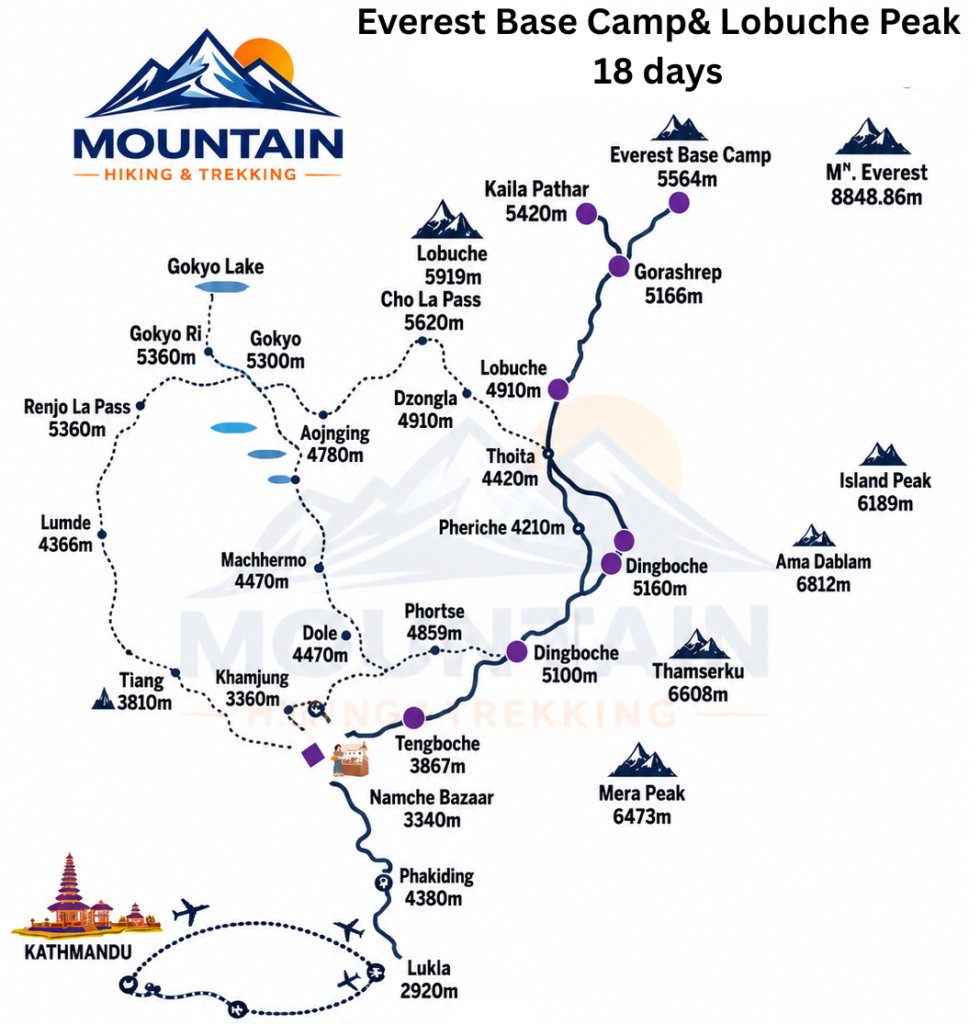
Everest Base Camp with Lobuche Peak Climbing starts with an early moning flight (around 30 minutes) from Kathmandu or Ramechhap to the famous Lukla airstrip, the gateway to the Everest region. Enjoy stunning views of Himalayan peaks during the flight. After landing, meet the rest of the crew and begin trekking. A gentle 3–4-hour hike through pine forests and along the Dudh Koshi River brings you to the village of Phakding.
Day 4: Trek from Phakding to Namche Bazaar (3,440 m) Gateway to the Everest Region
Cross several high suspension bridges draped with prayer flags as you follow the Dudh Koshi valley upstream. Enter Sagarmatha National Park at Monjo and tackle a long uphill stretch. After 6–7 hours of trekking, you’ll arrive at Namche Bazaar, the bustling Sherpa town and trading hub of the Khumbu. Weather permitting, you might catch your first glimpse of Everest en route.
Day 5: Acclimatization Day in Namche (3,440 m)
To adjust to the altitude, spend an extra day in Namche. Take an acclimatization hike to Everest View Hotel (3,880 m) for panoramic views of Everest, Ama Dablam, and other peaks. Visit the Sherpa Culture Museum or browse the shops and bakeries in Namche. This active rest day helps your body prepare for higher elevations.
Day 6: Trek from Namche Bazaar to Tengboche (3,860 m), Monastery & Mountain Views
Trek along a scenic trail with views of Everest, Lhotse, and Ama Dablam across the valley. Visit the river, have lunch at Phunki Thenga, then ascend through rhododendron and pine forests to Tengboche. Here you will visit the famous Tengboche Monastery, the spiritual center of Khumbu, set against a backdrop of towering mountains. Hiking time ~5 hours.
Day 7: Trek from Tengboche to Dingboche (4,410 m), Entering the High Alpine Zone
Continue through forests to Deboche and cross the Imja Khola. Pass quaint Sherpa villages like Pangboche as the landscape gradually becomes more rugged and open. Reach Dingboche, a farming village in a broad valley under Ama Dablam, after about 5 hours of trekking. You’ll notice the treeline has vanished, and yaks graze on the alpine pastures.
Day 8: Acclimatization Day in Dingboche (4,410 m), Hike & Rest for Altitude Gain
Another scheduled rest day for altitude adaptation. Take a moning hike up Nangkartshang Hill (~5,083 m) for spectacular 180u00b0 views of Makalu, Lhotse, and Cho Oyu. Retun to Dingboche for lunch and spend the aftenoon resting. By now, you’ll be feeling the thin air, so proper acclimatization is crucial.
Day 9: Trek from Dingboche to Lobuche (4,910 m), Through Thukla Pass & Glacier Views
Climb gradually to the windswept memorial area at Thukla Pass, where monuments honor climbers lost on Everest. Then follow the lateral moraine of the Khumbu Glacier to the small settlement of Lobuche. The 4 to 5 hour trek offers emerging views of Pumori, Nuptse, and Lobuche Peak itself looming above. You’re now very close to Everest Base Camp.
Day 10: Trek to Gorak Shep (5,140 m) & Everest Base Camp (5,364 m), Ultimate Base Camp Experience
An exciting and demanding day. Trek about 2–3 hours from Lobuche to Gorak Shep, the last lodge outpost. After a short rest, continue on a rocky trail following the Khumbu Glacier to reach Everest Base Camp – the iconic site where climbers gather for Everest expeditions. You’ll stand at the foot of the world’s highest mountain among colorful prayer flags and expedition tents. Savor the moment, take photos, and then retun to Gorak Shep for the night. (Distance from Lobuche to EBC via Gorak Shep is 8 km round-trip, taking about 6–7 hours total.)
Day 11: Early Morning Kala Patthar (5,550 m) Sunrise Hike & Return to Lobuche
Wake up before dawn for a steep hike up Kala Patthar, a famous viewpoint at 5,545 m. Reaching the summit around sunrise offers a breathtaking close-up of Mount Everest, Nuptse, Pumori, and the surrounding peaks bathed in golden light. After celebrating your achievement, descend back to Gorak Shep for breakfast. Then retrace your steps down to Lobuche. This is a long day (6+ hours), but your acclimatization and the inspiration of Everest’s view will carry you through.
Day 12: Trek to Lobuche High Camp (5,400 m), Preparation for Peak Climbing
The climbing phase begins. From Lobuche village, you’ll leave the main EBC trail and hike toward Lobuche Base Camp (around 5,000 m) and further up to High Camp (5,400 m) on a rocky plateau. The terrain is rugged, and you may need to scramble over rocks near the camp. In the aftenoon, your climbing guide will conduct a pre-climb training session. You will practice using crampons, ice axe, haness, and ropes, essential skills for the summit push. Ovenight in a tented camp at High Camp, with an early dinner and rest, as a very early start is planned for summit day.
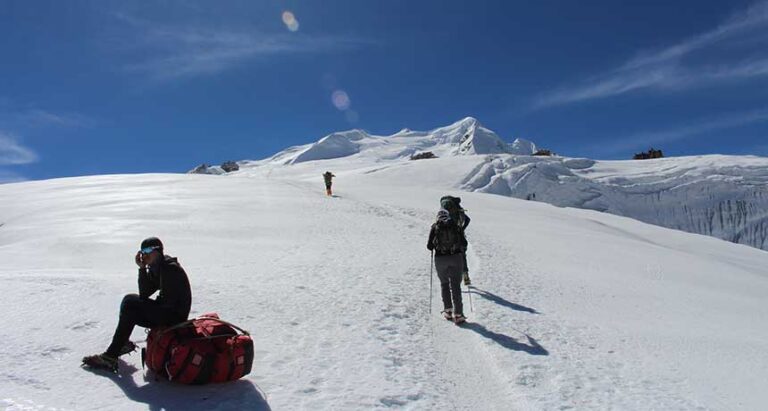
Day 13: Summit Lobuche East (6,119 m) & Descend to Pheriche (4,240 m) Summit Achievement Day
Summit Day! Wake up around midnight for a quick hot drink and final gear check. By 1 to 2 AM, start ascending the snowy slopes of Lobuche East by headlamp. It i s a steep climb on rock and ice, with fixed ropes in the steeper sections. At Crampon Point” (5,800 m) you will put on crampons for the glacier and snow sections. Using ascenders on fixed lines, you steadily climb the 45u00b0 slope towards the summit ridge. After 5 to 7 hours of tough climbing, reach the Lobuche East summit (6,119 m) at dawn or early moning! From the top, the panorama is unbelievable – you are surrounded by the giants of the Himalaya, including Everest, Lhotse, Makalu, Cho Oyu, Pumori, and countless other peaks. Take time to soak in the 360 view and savor your victory. Congratulations, you have climbed Lobuche East!
Day 14: Contingency / Extra Day
An extra day is built into the itinerary as a buffer. If bad weather or any unforeseen event prevented the summit on Day 13, this day gives another chance to attempt Lobuche Peak. If you submitted as planned, you can use the day to rest in Pheriche or explore the area. (If not needed for climbing or rest, this buffer day can also be used at the end in Kathmandu for sightseeing.)
Day 15: Trek from Pheriche to Namche Bazaar (3,440 m) Long Descent Back to Civilization
Having completed the climb, you will trek back at a relaxed pace. The route descends through Orsho and Pangboche, then climbs slightly to Tengboche and back to Namche Bazaar. With the bulk of the adventure behind you, you can enjoy the retun jouney and notice how the air feels thicker and the surroundings greener as you lose elevation. Trek ~6 to 7 hours.
Day 16: Trek from Namche Bazaar to Lukla (2,840 m) Final Day on Everest Trails
The final day of trekking is a long descent of ~7 hours, retracing the route down the Dudh Koshi valley. Pass by Monjo, exit Sagarmatha National Park, and continue through Phakding before the last short climb to Lukla. By the aftenoon, you will arrive in Lukla and toast to a successful trek and climb with your team.
Day 17: Fly Lukla to Kathmandu
Say goodbye to the Khumbu as you take a moning flight from Lukla back to Kathmandu (weather permitting). Enjoy one last aerial view of the mountains. Back in Kathmandu, you will be transferred to your hotel. The rest of the day is free to relax, enjoy a hot shower, and perhaps celebrate with a team dinner.
Day 18: Departure from Kathmandu

Your Everest Base Camp & Lobuche Peak adventure comes to an end. Depending on your flight schedule, you might have time for some last-minute souvenir shopping or sightseeing. Overland Trek Nepal will arrange your airport transfer. Take home incredible memories and a sense of pride for conquering both Everest Base Camp and Lobuche East!
Includes/Excludes
What's Included?
- Airport pick-up and drop-off in Kathmandu by private vehicle
- Domestic flights Kathmanduu to Lukla to Kathmandu
- Everest Base Camp trek with licensed English-speaking guide and porter support
- Lobuche Peak climbing permit with experienced climbing Sherpa support
- Full board meals during trek and climb with tea house and camping accommodation
- Porter service (1 porter for every 2 trekkers, maximum 25 kg)
- Emergency oxygen support carried for high-altitude safety
- Drinking water purification tablets
- All meals during the trek Breakfast, Lunch and Dinner with Tea or coffee
- All sightseeing entrance fees in Kathmandu
- 1-hour complimentary massage after the trek in Kathmandu
- Welcome dinner with a traditional Nepali cultural show in Kathmandu
- Best Teahouse accommodation during the trek
What's Excluded?
- International airfare to and from Nepal
- Nepal visa fees on arrival USD 30 for 15 days USD 50 for 30 days UDS 125 for 90 days
- (personal Climbing Eqipment Rent from chukung This Renting charge you can pay to chukung directly youself.
- Travel and medical insurance (including emergency evacuation)
- Tips for guide, porter, and climbing Sherpa
- Personal expenses (drinks, snacks, laundry, souvenirs, etc.)
- Additional costs caused by changes in itinerary (weather, flight delays, health issues, etc.)
- Extra hotel nights or accommodation upgrades not mentioned in the itinerary
- Lunch & Dinner in Kathmandu befor trek and after trek
Packing List
 Trekking Equipment
The following is a list of clothing and accessories that we recommend for treks and climbs in Nepal. This is not intended to be a comprehensive clothing and equipment list, rather it is intended to act as a reminder of those items that we feel are essential for your comfort and convenience. However we recognize that you may have your own personal preferences for clothing which may be equally as suitable.
For Head
- Sun hat or scarf
- Light balaclava or warm fleece hat
- Sunglasses with UV protection
- Upper Body
- T-shirts (2)
- Light and expedition weight thermal tops
- Fleece jacket or pullover
- Fleece Wind-Stopper jacket (optional)
- Waterproof (preferably breathable fabric) shell jacket
- Down vest and/or jacket (optional)
For Hands
- Lightweight gloves
- Heavyweight gloves or mittens with a waterproof shell outer
- Lower Body
- Underwear (4)
- Hiking shorts (2)
- Lightweight cotton long pants
- Light and expedition weight thermal bottoms
- Fleece or wool pants
- Waterproof (preferably breathable fabric) shell pants
For Feet
- Thin, lightweight inner socks (4)
- Thick, warm wool hiking socks (4)
- Hiking boots with spare laces
- Camp shoes (sneakers and/or sandals)
- Gaiters (Optional)
- Accessories
- Sleeping bag rated -10C. to -20C (Depending on trekking region)
- Headlamp (e.g. Petzl Zoom) with spare bulbs and batteries
- Small pad or combination lock-to-lock trek bag
- Basic First Aid Kit (see Health and Medicinal)
- Large plastic bags - for keeping items dry inside trek bags
- Daypack (approximately 2500 to 3000 cubic inches)
- Thermarest sleeping pad (Only Camping Trek)
- Water bottles (2)
- Toiletries
- Small wash towel
- Optional items
- Binoculars
- Books (Highly Recommended)
- Compass
- Playing cards/backgammon/chess set
- Swiss Knife
Recommended Mountaineering Kit
In addition to the items mentioned above for trekking, the following is a list of the additional specialized items which are required for the trekking peaks.
- Plastic or leather mountaineering boots, with gaiters and crampons that have been tested for a good fit.
- Fleece trousers or silhouette
- Additional mits and gloves suitable for climbing
- Ice axe, and ski poles (note - ice axes can be rented in Kathmandu)
- Climbing helmet
- Alpine climbing harness.
- 2 x tape slings
- 2 x screwgate karabiners
- Descender/abseil device
- Ascender
Essential Information
Travel insurance
Travel Insurance is mandatory for all customers who looking to travel in Nepal with the Mountain Hiking & Trekking .The Travel Insurance must cover both the evacuation and medical cost
There are many insurance companies that offer travel insurance services over the internet. You can choose from a wide variety of insurance companies as per your convenience. Especially when it comes to trekking in Nepal, there is always a narrow chance of minor health issues, injuries and most importantly – altitude sickness.
It is essential that you prefer an insurance rule that covers the cost of the helicopter rescue from the mountains in case of main accidents and delicate mountain sickness (AMS). through such great cases of an emergency evacuation, a helicopter service is the only way out of the mountains. This includes a rescue team for both – ground evacuation and rescue. Which is why we need your travel insurances to cover the cost of helicopter services and evacuation from the Himalayas
It is forever recovered to be safe than apologetic.
Before you plan your trip with Mountain Hiking & Trekking do make sure that your travel insurance covers all the costs mentioned above from a reliable company.
Suggested Travel Insurance Companies:
https://www.mondial-assistance.ca
https://www.travelassistnetwork.com/
https://www.travelex-insurance.com/
https://www.hccmis.com/atlas-travel-insurance
Any cancellation by a Client must be made in writing and acknowledged by the Company, the date on which the request to cancel is received by the Company, will determine the cancellation charge
Cancellation of Nepal,Bhutan and Tibet Trips deposit amount is ( Non- Refundable) But you can use That deposit anytime when you come to nepal.
a) The Client is strongly advised to take out cancellation insurance at the time of making the booking.
b) No refunds will be made if you voluntarily leave a trip for any reason after the trip has start on,No refunds will be made for any accommodation, transport, sightseeing, meals or services not utilized.
c) If you want to change the date of the tour, it is possible to change within our tour date (subject to availability) which may occur some additional cost for you.
d) We will take last minute booking till 5 day prior of tour date for Nepal trips and till 20 days prior for Bhutan and Tibet trips and you need to make full payment to book the tour in these cases.
Cancellation Of A Tour By The Company:
Mountain Hiking & Trekking P. Ltd reserves the right to cancel any trip, including a guaranteed trip, prior to departure due to reasons beyond our control (due to natural disasters, flight cancellation, , industrial action, Mountain sickness, weather conditions and Early back to kathamandu from Trek or any Tour in nepal,bhutan and Tibet trip. In such a case, Mountain Hiking & Trekking P. Ltd will not refund any money
Passport And Visas:
All clients must have a valid passport with at least 6 months validity from return date, Nepalese visas can be obtained from the Nepalese Embassies or Consulate in your country or arrival in Kathmandu Airport. Please visit our Nepal Visa for the detail info.
Complaints:
If you have complaints about the trip, you can tell to operator/leader/guide at the earliest opportunity then he will take the appropriate action.
Acceptance Of Risk:
We are committed to provide the best services by performing our duties honestly & seriously to make your journey very smooth & successful. However, Mountain Hiking & Trekking P. Ltd and its related organization shall not be responsible for any changes in the itinerary due to unavoidable circumstance beyond our control such as govt. restriction, Land slide, road blockage, flood, snow political unrest, cancellation of flight, delay, sickness or accident and The nature of some of our trips is adventurous and risky as well, therefore may involve a personal risk. We would like to inform you that you have to take all risk on yourself such as damages or injuries or death resulting from these inherent risks.
Route Map
FAQ
How difficult is Everest Base Camp with Lobuche Peak Climbing
Everest Base Camp with Lobuche Peak Climbing is considered challenging. The trek requires good physical fitness,strong endurance and basic mountaineering skills.The trek portion is moderate to difficult while the summit day for lobuche peak is more echnical and may involve fixed ropes,crampons and ice axes.
Do i need previous climbing experience for Lobuche Peak
Previous mountaineering experience is helpful but not mandatory. Beginner with good fitness can join if they are prepared physically. Most guided expendition provide pre climb training on using climbing equipment.
What is the maximum altitude of the trip?
The highest point of the trip is the summit of Lobuche East at approximately 6,119 meters (20,075 Ft). Everest Base Camp lies at around 5,364 meters.
How Long does the Everest Base Camp with Lobuche Peak trip take?
The itinerary usually takes around 15-20 days depending on acclimatization days, weather conditions, and flight schedules
Is altitude sickness a concern on this trek?
Yes.Since the trek reaches above 6,000 meter, there is a risk of altitude sickness.Proper acclimatization days,hydration and gradual ascent help reduce the risk
What permits are required for everest base camp and lobuche Peak climbing?
You generally need the sagarmatha National Park Permit,Khumbu Pasang Lhamu rural,Municipality permit, and Lobuche Peak Climbing permit but no need to worry MHT will help u to get all permit so no need to worry
Can i rent climbing equipment in Kathmandu
Yes.Essential climbing gear such as crampons, harnesses, ice axex, helmets, and sleeping bags can usually be rented in kathmandu
Are guide and porters included?
Yes MHT provide u professional guide who will help u through aout the trek and porters to.