Annapurna Circuit Trek with poon hill
Trip Facts
 Duration
16
Duration
16
 Trip Grade
Moderate
Trip Grade
Moderate
 Country
Nepal
Country
Nepal
 Maximum Altitude
(5,416 meters/17,769 feet)
Maximum Altitude
(5,416 meters/17,769 feet)
 Group Size
2
Group Size
2
 Starts
Kathmandu
Starts
Kathmandu
 Ends
Kathmandu
Ends
Kathmandu
 Activities
Trekking & tour
Activities
Trekking & tour
 Best Time
Mar,Apr,May,,Oct,Nov,Dec
Best Time
Mar,Apr,May,,Oct,Nov,Dec
Overview
Annapurna Circuit trekking has been recognized as one of the World’s best trekking trails according to a survey by Modern Maturity (USA). This is a dramatic trek around the mighty Annapurna range, a journey that is regarded as one of the top ten walks in the world. Exploring the beautiful Annapurna region, you shall reach the highest point of the trek—the Thorong La Pass situated at an altitude of 5,416 meters. Passing through the settlements inhabited by Gurung, Thakali, and Manag communities, you shall enjoy every step you take in this beautiful region.
You shall explore the breathtaking landscape and rich cultural practices during this trek added with the adventure. This Classic Annapurna lodge trek is certainly enjoyed by trekkers from all around the world. Annapurna circuit trek was opened for foreign trekkers in 1977. You shall be trekking via the lush green forests, passing several small and large settlements, crossing through several suspension bridges, beside waterfalls, witnessing the staggering views of majestic mountains soaring high above you, and a peaceful spiritual attachment shall slowly engulf you as you pass beside several Mani Walls, Chortens, and monasteries.
With an aim to help you make most out of this trek, we have made some variations in the popular trekking routes. From Kathmandu, you shall ride all the way to Besisahar and start trekking from thereon. Trekking alongside the Marsyandi River, you shall pass through terraced fields, ascending and descending via the beautiful villages, witnessing the Annapurna range and other mountains. As we ascend, the valley becomes narrower, waterfalls plummet from high above, and the scenery gains a rugged alpine appearance.
The highest point of the Annapurna Circuit trekking is Thorong La pass at the top of the valley at 5,416m/17,765ft high. Due to the difficulties of crossing the pass, the circuit is usually walked in a counter clockwise direction. Traveling anti clockwise, the longer ascent and shorter descent from west to east is too much for many people to manage in one day. As we trek north of the Great Himalayan Divide there is a dramatic change as we enter the stark landscape of the Tibetan Plateau where the culture becomes predominantly Buddhist. We then head back down the great Kali Gandhaki Valley, which is believed to be the deepest gorge in the world. Our experienced local guide will take you through the revised route along the Valley to avoid road under construction between Muktinath to Kalopani. This section of our trek shall detour to follow the footpaths through pretty villages away from the road, but returns to the traditional circuit villages for overnight lodge stays.
Route
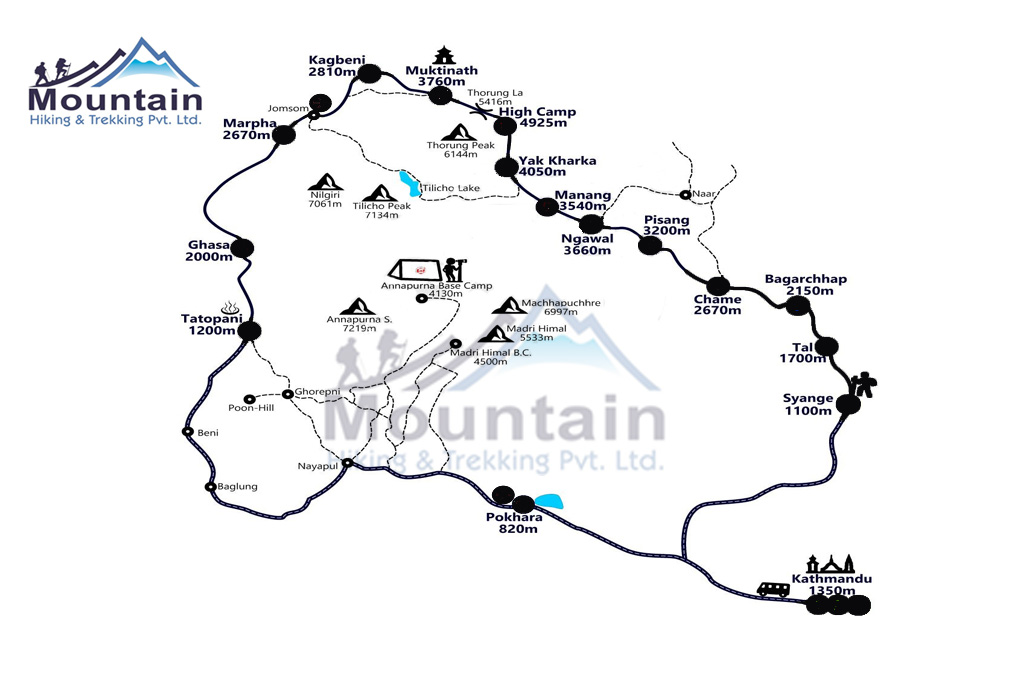
Kathmandu (1,345 m)- Besisahar (830 m)-Syange-Chamje (1,400 m)-Bagarchhap (2,160 m)-Chame (2,630 m)-Pisang (3,300 m)-Manang (3,540 m)-Yak Kharka (4,000 m)-Thorong Phedi (4,450 m)-Thorong La Pass (5,416 m)-Muktinath (3,800 m)-Marpha (2,670 m)-Kalopani (2,530 m)-Tatopani (1,200 m)-Ghorepani (2,850 m)-Tadapani (2,700 m)-Ghandruk-Pokhara (850 m)-Kathmandu (1,345 m)
Difficulty
Annapurna Circuit Trekking is a moderate level of trekking; it doesn’t involve any technical climbing. The only challenge you might face during this trek is while crossing the Thorong La Pass. Otherwise, you might not feel the trek too strenuous. You do not require any athletic body fitness to complete this trek. Ensure that you can do long duration of walking uphill and downhill for some days in a row. Also ensure that you don’t have any problems with your knees and ankles or any part that might directly hamper trekking. Altitude sickness can be another challenge that you might have to face during this trek. To avoid this you shall take sufficient time for acclimatization to let you adapt to the growing altitude. Taking sufficient rests, you shall complete this trek successfully.
Food and Accommodation
You shall get typical Nepalese local dishes, with some international varieties throughout your trek. However, taking the pervasive dish Dal Bhat for lunch is highly recommended. You shall be served with rice, lentils, green vegetables and other varieties of vegetables, Papad, pickles made locally, and salad. Macaroni, potatoes, noodles, spaghetti, etc. are some other alternatives to Dal Bhat. Similarly, there are plenty of teahouses, lodges, and hotels to stay at. However, the higher you ascend the limited the facilities in the accommodation become, serving with beds, blankets, and sometimes shared a bathroom.
Best Season
March through to May, and September through to November are considered the best time to do any trek in Nepal, including the Annapurna Circuit Trekking. During March through to May, though it might be pretty hot in the lower altitude areas of the Annapurna region, you shall be welcomed by the blooming red rhododendrons. This is also the time just before the starting of the monsoon, thus, you should not worry about the rainfall. Also, September through to November is the best time; the lower areas of the region aren’t too hot, and the high altitude areas aren’t too cold, either. But the nights can be pretty chilly and cold. Sometimes traveling during the extreme season during winter can make your trekking miserable.
Highlights
Spectacular Mountain Views: The Annapurna Circuit provides breathtaking views of some of the world's highest peaks, including Annapurna I (8,091 meters), Dhaulagiri (8,167 meters), Manaslu (8,163 meters), and Machapuchare (6,993 meters). The sunrise from Poon Hill is particularly famous for its panoramic mountain vistas.
Thorong La Pass: Crossing Thorong La Pass at 5,416 meters (17,769 feet) is a significant achievement. It's one of the highest trekking passes in the world and offers stunning views in all directions.
Diverse Landscapes: The trek takes you through a variety of landscapes, from subtropical forests and terraced fields in the lower regions to alpine meadows, barren highlands, and glacial terrain at higher elevations. The transition is captivating.
Cultural Diversity: You'll encounter diverse cultures and ethnic groups along the way, including Gurungs, Magars, Thakalis, and Tibetans. Explore traditional villages, monasteries, and learn about their unique customs and lifestyles.
Hot Springs: Enjoy the natural hot springs in Tatopani, perfect for relaxing and soothing sore muscles after long days of trekking.
Poon Hill: The sunrise view from Poon Hill is a must-see. It offers a stunning panorama of the Annapurna and Dhaulagiri mountain ranges, painted with hues of red and orange as the sun rises.
Manang: This picturesque village is a great place for acclimatization. It has a rich Tibetan culture, and you can visit monasteries and interact with the locals.
Muktinath: A sacred pilgrimage site for Hindus and Buddhists, Muktinath offers a unique blend of religion and nature. The 108 water spouts and the eternal flame are fascinating.
Ghorepani: A charming village with a pleasant atmosphere and the opportunity to visit Poon Hill for sunrise views.
Traditional Teahouses: Stay in traditional teahouses along the route, which provide basic accommodations and a chance to interact with other trekkers.
Rich Flora and Fauna: The trek passes through protected areas, providing opportunities to spot diverse flora and fauna, including rhododendrons, orchids, and various bird species.
Diverse Culinary Experiences: Savor a variety of local and international dishes at the teahouses, including dal bhat (lentil soup and rice), momo (dumplings), and yak cheese.
Warm Hospitality: Experience the warm hospitality of the Nepali people and the kindness of the villagers along the trail.
Unique Suspension Bridges: Cross some of the iconic suspension bridges over the Marsyangdi River, adding an adventurous element to your trek.
Sense of Accomplishment: Completing the Annapurna Circuit is a significant accomplishment for trekkers. It's a journey of self-discovery and offers a profound connection with nature and culture.
Why Travel With Us
Customer Support
With 24-hour customer service, customers can get help whenever they need it, which can lead to increased customer satisfaction and loyalty.
Safety Equipment
We carry all necessary safety equipment including hyperbaric chambers, automated external defibrillators, pulse oximeters, and general first aid kits.
Our first priority is your safety on the mountain.
Our purpose
To provide our customers with unforgettable and safe trekking experiences that connect them with natural beauty, and support local communities and local culture.
Certified Tour Operator
We are a certified Trek and Tour operator with Nepal Tourism Board, Trekking Agencies Association of Nepal, and Nepal Mountaineering Association. And we are local Sherpa tour company of Nepal.
No Extra Fees
There is no additional fee for paying by credit card. Airport transfers are included both on arrival and departure. All taxes and government fees are included in all our packages.
Free Nepali & Sherpa Food Cooking Classes - The Best Way to Learn!
Start a culinary journey with our free Nepalese and Sherpa cooking classes. Discover authentic recipes, hands-on cooking, and cultural insights into Himalayan cuisine. Explore Traditional Cuisine: Learn to prepare iconic dishes like momos (dumplings), dal bhat (lentils and rice), thukpa (noodle soup), and more. Perfect for food enthusiasts and travelers alike. Join us for an unforgettable experience!
Social Media Updates
During every trek, we do our best to post social media updates with photos to our Facebook Group or our Instagram Stories. This way your family and friends can watch your progress during your trek.
Itinerary
Day 1: Arrival in Kathmandu airport (1345meters).

There you will be met by our Airport Representative and transferred to hotel by private tourist vehicle. Ovenight at hotel.
Day 2: Full Day city Tour in Kathamandu city 5/6 hrs
Day 3: Kathamandu to Besisahar drive 175 km.about 109 miles. 5/6 hrs.
Day 4: Drive from Besisahar to Dharapani (1,960m / 6,430 ft) Approx. 4 to 5 Hours
Day 5: Trek from Dharapani to Chame (2,670m / 8,760 ft) Approx. 5 to 6 Hours
Day 6: Trek from Chame to Upper Pisang (3,300m / 10,827 ft) Approx. 4 to 6 Hours
The trail narrows as you walk through a steep and deep valley with dramatic rock walls. Climb steadily through forests and small settlements until reaching Upper Pisang, which offers stunning views of Annapuna II and IV.
Meals: Breakfast,Lunch and Dinne
Acomodation Best Available Mountain Lodge/ Guest House
Day 7: Trek from Upper Pisang to Manang (3,540m / 11,614 ft) Approx. 5 to 6 Hours
Take the high trail via Ghyaru and Ngawal for more dramatic mountain views and fewer tourists. This route provides spectacular panoramas of Annapuna III, Gangapuna, and Tilicho Peak. Reach Manang, a beautiful village nestled beneath towering peaks.
Meals: Breakfast,Lunch and Dinne
Acomodation Best Available Mountain Lodge/ Guest House
Day 8: Rest and Acclimatization Day at Manang
Day 9: Trek from Manang to Ledar (4,250m / 13,944 ft) Approx. 4 to 5 Hours
Day 10: Trek from Ledar to Thorong High Camp (4,925m / 16,158 ft) Approx. 4 to 5 Hours
Day 11: Cross Thorong La Pass (5,416m) and Trek to Muktinath (3,700m)
Day 12: Muktinatha to Tatopani Drive 1190 m./ 3,904 ft 5/6 hrs drive
Day 13: Tatopani to Ghorepani( 2,874 m./ 9,429 fit.) 15 to 16 kilometers. 6/7 hrs
Day 14: Hike to Poon Hill trek to Tikhedunga (1,540 m/5,052 ft), drive to pokhara
Day 15: goodbye to the beautiful lake city of Pokhara 6/7 hrs drive
Day 16: Your adventure in Nepal comes to an end today.

Our adventure in Nepal comes to an end today! A Mountain Hiking representative will escort us to the airport approximately 3 hours before our scheduled flight.
On our way home, we have plenty of time to plan our next adventure in the wonderful country of Nepal.
Fixed Departures
Choose a scheduled departure date with live availability and direct booking access.
Annapurna Circuit Trek with poon hill
Annapurna Circuit Trek with poon hill
Annapurna Circuit Trek with poon hill
Annapurna Circuit Trek with poon hill
Annapurna Circuit Trek with poon hill
Annapurna Circuit Trek with poon hill
Annapurna Circuit Trek with poon hill
Annapurna Circuit Trek with poon hill
Annapurna Circuit Trek with poon hill
Annapurna Circuit Trek with poon hill
Annapurna Circuit Trek with poon hill
Annapurna Circuit Trek with poon hill
Annapurna Circuit Trek with poon hill
Annapurna Circuit Trek with poon hill
Annapurna Circuit Trek with poon hill
Annapurna Circuit Trek with poon hill
Annapurna Circuit Trek with poon hill
Annapurna Circuit Trek with poon hill
Annapurna Circuit Trek with poon hill
Annapurna Circuit Trek with poon hill
Annapurna Circuit Trek with poon hill
Annapurna Circuit Trek with poon hill
Annapurna Circuit Trek with poon hill
Annapurna Circuit Trek with poon hill
Annapurna Circuit Trek with poon hill
Annapurna Circuit Trek with poon hill
Annapurna Circuit Trek with poon hill
Annapurna Circuit Trek with poon hill
Annapurna Circuit Trek with poon hill
Annapurna Circuit Trek with poon hill
Annapurna Circuit Trek with poon hill
Annapurna Circuit Trek with poon hill
Annapurna Circuit Trek with poon hill
Annapurna Circuit Trek with poon hill
Annapurna Circuit Trek with poon hill
Annapurna Circuit Trek with poon hill
Annapurna Circuit Trek with poon hill
Annapurna Circuit Trek with poon hill
Annapurna Circuit Trek with poon hill
Annapurna Circuit Trek with poon hill
Annapurna Circuit Trek with poon hill
Annapurna Circuit Trek with poon hill
Annapurna Circuit Trek with poon hill
Annapurna Circuit Trek with poon hill
Annapurna Circuit Trek with poon hill
Annapurna Circuit Trek with poon hill
Annapurna Circuit Trek with poon hill
Annapurna Circuit Trek with poon hill
Private Trip
Looking for a personalized experience? We organize privately guided journeys tailored to your travel dates, group size, and pace. Please fill out the form below to get started.
Includes/Excludes
What's Included?
- Airport pick-up and drop-off in Kathmandu or Pokhara
- Licensed English-speaking trekking guide and porter support
- Annapurna Conservation Area Permit (ACAP) and TIMS card
- Full board meals (breakfast, lunch, dinner) during trek
- Tea house accommodation during trekking (twin sharing)
What's Excluded?
- International airfare to and from Nepal
- Nepal visa fee
- Personal expenses (drinks, snacks, laundry, etc.)
- Travel insurance (including emergency rescue)
- Tips for guide and porter
Packing List
 Trekking Equipment
The following is a list of clothing and accessories that we recommend for treks and climbs in Nepal. This is not intended to be a comprehensive clothing and equipment list, rather it is intended to act as a reminder of those items that we feel are essential for your comfort and convenience. However, we recognize that you may have your own personal preferences for clothing which may be equally as suitable.
For Head
- Sun hat or scarf
- Light balaclava or warm fleece hat
- Sunglasses with UV protection
- Upper Body
- T-shirts (2)
- Light and expedition weight thermal tops
- Fleece jacket or pullover
- Fleece Wind-Stopper jacket (optional)
- Waterproof (preferably breathable fabric) shell jacket
- Down vest and/or jacket (optional)
For Hands
- Lightweight gloves
- Heavyweight gloves or mittens with a waterproof shell outer
- Lower Body
- Underwear (4)
- Hiking shorts (2)
- Lightweight cotton long pants
- Light and expedition weight thermal bottoms
- Fleece or wool pants
- Waterproof (preferably breathable fabric) shell pants For Feet
- Thin, lightweight inner socks (4)
- Thick, warm wool hiking socks (4)
- Hiking boots with spare laces
- Camp shoes (sneakers and/or sandals)
- Gaiters (Optional)
- Accessories
- Sleeping bag rated -10C. to -20C (Depending on trekking region)
- Headlamp (e.g. Petzl Zoom) with spare bulbs and batteries
- Small pad or combination lock-to-lock trek bag
- Basic First Aid Kit (see Health and Medicinal)
- Large plastic bags - for keeping items dry inside trek bags
- Daypack (approximately 2500 to 3000 cubic inches)
- Thermarest sleeping pad (Only Camping Trek)
- Water bottles (2)
- Toiletries
- Small wash towel
- Optional items
- Binoculars
- Books (Highly Recommended)
- Compass
- Playing cards/backgammon/chess set
- Swiss Knife
Recommended Mountaineering Kit
- Plastic or leather mountaineering boots, with gaiters and crampons that have been tested for a good fit.
- Fleece trousers or silhouette
- Additional mits and gloves suitable for climbing
- Ice axe, and ski poles (note - ice axes can be rented in Kathmandu)
- Climbing helmet
- Alpine climbing harness.
- 2 x tape slings
- 2 x screwgate karabiners
- Descender/abseil device
- Ascender
Essential Information
Nepal Visa Information
All foreigners need visas, except people from India.
Visa Types: Nepal offers various types of visas, including tourist visas, business visas, student visas, and more.
Tourist Visa: Tourist visas are typically the most common type for travelers visiting Nepal for leisure or sightseeing purposes.
Visa on Arrival: Many nationalities can obtain a tourist visa upon arrival at Tribhuvan International Airport in Kathmandu and other entry points. You'll need to fill out a visa application form and provide a passport-sized photo along with the visa fee in USD or equivalent.
Online Visa Application: Some nationalities are eligible to apply for a tourist visa online through the Nepal Immigration website. https://nepaliport.immigration.gov.np/This allows you to complete the visa application in advance and obtain a visa approval letter, which you present upon arrival to receive your visa.
Print the Approval Letter: Print out the visa approval letter, as you'll need to present it upon arrival in Nepal along with your passport. Make sure to carry a copy of the approval letter with you during your travel.
Obtain Visa Stamp Upon Arrival: Upon arrival at Tribhuvan International Airport in Kathmandu or other entry points in Nepal, present your passport, printed visa approval letter, and any other required documents to the immigration officer. They will stamp your passport with the tourist visa, allowing you to enter Nepal.
Duration and Extension: Tourist visas are typically issued for 15, 30, or 90 days. Extensions are possible for up to 150 days per visa year (January-December) at the Immigration Office in Kathmandu and certain other locations.
Visa Fees: The visa fee varies depending on the duration of your stay. There may be additional fees for visa extensions.
15 Days – USD 30
30 Days – USD 50
90 Days – USD 125
Passport Validity: Your passport should be valid for at least six months beyond the intended date of departure from Nepal.
Travel Insurance: Purchase travel insurance that covers high-altitude trekking and helicopter evacuation in case of emergencies. Make sure to carry a copy of your insurance policy and emergency contact information.
Be Flexible: Weather conditions in the Himalayas can be unpredictable. Be prepared for flight delays or cancellations due to poor weather conditions in Lukla, which can affect your trekking schedule. Stay flexible and patient.
Permits:
TIMS (Trekkers' Information Management System) Card: This card is mandatory for all trekkers in Nepal to ensure their safety.
Annapurna Conservation Area Permit (ACAP): Required to enter the Annapurna Conservation Area.
Packing List:
Clothing: Layered clothing for varying temperatures, waterproof jacket, trekking pants, thermal wear, gloves, and a warm hat.
Footwear: Sturdy, waterproof trekking boots and comfortable trekking socks.
Gear: Trekking poles, a good-quality backpack, a daypack, a sleeping bag (if not provided by tea houses), and a headlamp with extra batteries.
Accessories: Sunglasses, sunscreen, lip balm, a first aid kit, water purification tablets, and a reusable water bottle.
Personal Items: Toiletries, lightweight towel, and snacks.
Accommodation:
Tea Houses: The most common type of accommodation on the trek. They provide basic rooms, shared bathrooms, and meals.
Booking: Generally, you do not need to book tea houses in advance, but during peak seasons (spring and autumn), it may be wise to book a day or two ahead, especially at higher altitudes like ABC.
Food and Water:
Meals: Available at tea houses along the trail. Typical meals include dal bhat (rice and lentil soup), noodles, pasta, and various potato dishes.
Water: Bottled water is available, but using water purification tablets or a filter to purify tap or stream water is more environmentally friendly and cost-effective.
Altitude Sickness:
Awareness: Symptoms include headaches, nausea, dizziness, and shortness of breath.
Prevention: Ascend slowly, stay hydrated, avoid alcohol, and take rest days if needed. Diamox can be used as a preventive measure (consult a doctor before use).
Health and Safety:
Travel Insurance: Make sure your insurance covers high-altitude trekking and possible evacuation.
Emergency Contacts: Have the contact information for local rescue services and your country's embassy in Nepal.
Guide/Porter: Hiring a guide and/or porter can enhance safety and comfort. They provide valuable local knowledge and carry your gear, allowing you to enjoy the trek more fully.
Best Time to Trek:
Spring (March to May): Blooming rhododendrons and moderate temperatures.
Autumn (September to November): Clear skies, stable weather, and excellent visibility.
Winter (December to February): Fewer crowds but colder temperatures and possible snowfall.
Monsoon (June to August): Heavy rainfall, slippery trails, and potential landslides, but lush greenery and fewer trekkers.
Cultural Etiquette:
Respect Local Customs: Greet locals with "Namaste," dress modestly, and ask for permission before taking photographs.
Environmental Responsibility: Follow the principles of Leave No Trace. Dispose of waste properly, use biodegradable toiletries, and avoid single-use plastics.
Final Tips:
Physical Preparation: Engage in regular cardio exercises, strength training, and hiking to build stamina and endurance before the trek.
Mental Preparation: Be ready for long days of walking and changing weather conditions.
Money: Carry enough cash in Nepalese rupees for the trek, as ATMs are not available along the route.
Travel insurance
Travel Insurance is mandatory for all customers who looking to travel in Nepal with the Mountain Hiking & Trekking .The Travel Insurance must cover both the evacuation and medical cost
There are many insurance companies that offer travel insurance services over the internet. You can choose from a wide variety of insurance companies as per your convenience. Especially when it comes to trekking in Nepal, there is always a narrow chance of minor health issues, injuries and most importantly – altitude sickness.
It is essential that you prefer an insurance rule that covers the cost of the helicopter rescue from the mountains in case of main accidents and delicate mountain sickness (AMS). through such great cases of an emergency evacuation, a helicopter service is the only way out of the mountains. This includes a rescue team for both – ground evacuation and rescue. Which is why we need your travel insurances to cover the cost of helicopter services and evacuation from the Himalayas
It is forever recovered to be safe than apologetic.
Before you plan your trip with Mountain Hiking & Trekking do make sure that your travel insurance covers all the costs mentioned above from a reliable company.
Suggested Travel Insurance Companies:
https://www.worldnomads.com
https://www.mondial-assistance.ca
https://www.travelassistnetwork.com/
https://www.travelex-insurance.com/
https://www.travelite.com/
https://www.hccmis.com/atlas-travel-insurance
We encourage you to read the terms and conditions carefully before booking any trips with us, by submitting the booking form you are agreeing to be bound by the conditions of the terms and please go through the following Terms and Conditions that govern the relationship between you (client) and Mountain Hiking & Trekking P. Ltd) (hereinafter referred as "The Company"), Registered Company Number 74068/066/067, both parties agree to these Terms and Conditions to resolve any legal or other disputes that may arise during the trip.
Trip Booking:
A 'trip' refers to any product itinerary or activities that are listed in our official website www.himalayaguide.com that you buy from us including Trekking, Tours, Expeditions, and/or other adventure and tour programs.
A booking is accepted and becomes definite only from the date when the Company sends a confirmation email then the contract between the Company and the Client comes into existence.
Before your booking is confirmed and a contract comes into force, the Company reserves the right to increase or decrease prices.
Please note that the company would not be liable to any warranty, collateral agreement, prior agreement, description of services, or conditions, other than as expressed herein.
Deposit Requirement For Booking Trip:
I) Nepal Trips: For Nepal Trips, you will have to make a deposit of 25% of trip cost at the time of booking. The Deposit amount is nonrefundable. the remaining 75% amount is payable upon your arrival in Kathmandu and before the trip departure from Kathmandu.
The deposit should be sent to the Company, The Tailor Made trips may require a higher deposit or full payment at the time of booking so, if deposit is different from that outlined in this clause, you will be advised by the company at the time of booking.
II) Tibet/ Bhutan Trips: For the Booking of Tibet and Bhutan Trips, you will make 35% of the trip cost at the time of Booking. The Deposit amount is nonrefundable. and the remaining 60% is payable upon arrival in Kathmandu and before the trip departure.
Method of Payment
Booking deposit can be made by bank transfer, by Credit Card (Visa or Mastercard) and western union:
Booking paying by any credit card is Free of charge
http://www.himalayaguide.com/payment.html
if you want to pay by credit card we are 100% online secure payment systems
Payment via Wire/Bank Transfer: Our Bank Details for wire Transfer:
- Name of the Account Holder: - Mountain Hiking & Trekking P. LTD
- Account Number: - 00207405260011
- Account Type: - Current
- Paying Bank- Himalayan Bank LTD.
- Bank Address:- Thamel, Kathamandu, Nepal
- Post Box No: - 14444
- Swift Code: - HIMANPKA
Note: Bank service charge should be paid by the clients themselves at the time of deposit.
Please note that we are not liable of any delay or loss during the transfer process, If in case due to use of mediator bank or any other reasons if the money received by us is less than the amount sent, you are requested upon arrival to pay accordingly so that the total is equivalent to the product cost.
E-mail us the bank reference number or remittance slipserence number/remittance slips and sender details, and it will be easy for us to check. after you initiate the transfer, sometimes bank forwards the money with different name; if we have ref
Final Payment:
(a) Nepal Trips: Final payment on trekking, tours, climbing, expedition or any kind of trips in Nepal can be made upon arrival in Nepal and before the trip departure; final payment can be made by bank transfer, cash or by Credit Card (Visa or Master Card) and there is 0% surcharge when the payment is made by cards (this applies to final balances and trip extension only.
b) Tibet and Bhutan Trips: Final payment of Tibet and Bhutan Trips should be made before the 30 days prior of the tour date and final payment can be made by bank transfer, or by Credit Card (Visa or Master Card) and there is 0% surcharge when the payment is made by cards (this applies to deposits, final balances and trip extension only
Trip Cancellation By The Client
Any cancellation by a Client must be made in writing and acknowledged by the Company, the date on which the request to cancel is received by the Company, will determine the cancellation charge
Cancellation of Nepal,Bhutan and Tibet Trips deposit amount is ( Non- Refundable) But you can use That deposit anytime when you come to nepal.
a) The Client is strongly advised to take out cancellation insurance at the time of making the booking.
b) No refunds will be made if you voluntarily leave a trip for any reason after the trip has start on,No refunds will be made for any accommodation, transport, sightseeing, meals or services not utilized.
c) If you want to change the date of the tour, it is possible to change within our tour date (subject to availability) which may occur some additional cost for you.
d) We will take last minute booking till 5 day prior of tour date for Nepal trips and till 20 days prior for Bhutan and Tibet trips and you need to make full payment to book the tour in these cases.
Cancellation Of A Tour By The Company:
Mountain Hiking & Trekking P. Ltd reserves the right to cancel any trip, including a guaranteed trip, prior to departure due to reasons beyond our control (due to natural disasters, flight cancellation, , industrial action, Mountain sickness, weather conditions and Early back to kathamandu from Trek or any Tour in nepal,bhutan and Tibet trip. In such a case, Mountain Hiking & Trekking P. Ltd will not refund any money
Passport And Visas:
All clients must have a valid passport with at least 6 months validity from return date, Nepalese visas can be obtained from the Nepalese Embassies or Consulate in your country or arrival in Kathmandu Airport. Please visit our Nepal Visa for the detail info.
Complaints:
If you have complaints about the trip, you can tell to operator/leader/guide at the earliest opportunity then he will take the appropriate action.
Acceptance Of Risk:
We are committed to provide the best services by performing our duties honestly & seriously to make your journey very smooth & successful. However, Mountain Hiking & Trekking P. Ltd and its related organization shall not be responsible for any changes in the itinerary due to unavoidable circumstance beyond our control such as govt. restriction, Land slide, road blockage, flood, snow political unrest, cancellation of flight, delay, sickness or accident and The nature of some of our trips is adventurous and risky as well, therefore may involve a personal risk. We would like to inform you that you have to take all risk on yourself such as damages or injuries or death resulting from these inherent risks.
Route Map