Mustang Tiji Festival Trek
Trip Facts
 Duration
18
Duration
18
 Trip Grade
Moderate
Trip Grade
Moderate
 Country
Nepal
Country
Nepal
 Maximum Altitude
(4,130m/13,545ft)
Maximum Altitude
(4,130m/13,545ft)
 Group Size
2-15 People
Group Size
2-15 People
 Starts
Pokhara
Starts
Pokhara
 Ends
Jomsom
Ends
Jomsom
 Activities
Trekking
Activities
Trekking
 Best Time
Sep, Oct, Nov and Dec, Mar, Apr, May
Best Time
Sep, Oct, Nov and Dec, Mar, Apr, May
Overview
The Mustang Tiji Festival, also known as the Tenba or Tenba Jatra, is a religious celebration that takes place annually in the upper Mustang region of Nepal. It is a three-day festival that is held to mark the end of the winter season and to drive away evil spirits.
The Tiji Festival is based on the ancient Bon religion and is considered to be one of the most important cultural events in the region. During the festival, locals dress up in traditional costumes and perform dances and rituals to commemorate the victory of the deity Dorje Jono over a demon.
One of the highlights of the Tiji Festival is the colorful masked dances, where participants wear masks and perform intricate dances to represent various characters from the Bon religion. The festival also features various traditional foods and drinks, as well as horse races, archery competitions, and local games.
Visitors from all over the world come to witness the Mustang Tiji Festival, making it a significant cultural and tourist event in the region. The festival provides a unique insight into the rich cultural heritage of the Mustang region and is a great opportunity to experience the unique traditions and customs of the local people.
The Mustang Tiji Festival is a traditional festival celebrated annually in the Upper Mustang region of Nepal. The festival is held to mark the victory of good over evil and to bring an end to the suffering caused by natural disasters and disease. The festival is characterized by colorful masks, traditional dances, and religious ceremonies, and is attended by people from all over the region. The festival is also an opportunity for the local communities to come together, socialize, and exchange news and ideas.
Highlights
Overall, the Tiji Festival is a truly unique and memorable experience for travelers who are looking to immerse themselves in the culture and tradition of the Mustang region.
- Traditional Dances: One of the most exciting highlights of the Tiji Festival is the traditional dances performed by the local people. The dances are performed to the rhythm of traditional music and are meant to honor the gods and protect the village from evil spirits.
- Masked Dancers: Another highlight of the Tiji Festival is the masked dancers. The masked dancers wear elaborate costumes and masks and perform intricate dances to the beat of traditional drums and horns.
- Processions: The Tiji Festival is marked by several processions that take place throughout the village. The processions are led by the masked dancers and are accompanied by traditional music, songs, and prayers.
- Religious Ceremonies: The Tiji Festival is also marked by several religious ceremonies, including offerings to the gods and prayers for good health and prosperity. These ceremonies are performed by the local lamas and are an important part of the festival.
- Cultural Significance: The Tiji Festival has a deep cultural significance for the local people of Mustang. It is a celebration of their history and culture, and a time for them to come together and celebrate the end of winter and the arrival of spring.
Why Choose Us
We offer expertly crafted Mustang Tiji Festival treks with guaranteed festival departures, experienced licensed guides, and seamless permit handling for the restricted Upper Mustang region. Our small-group approach ensures personalized service, safe acclimatization, and a deeper cultural experience. With reliable logistics, comfortable stays, and a strong commitment to responsible trekking, we deliver a hassle-free and authentic Himalayan journey you can trust.
- Guaranteed Tiji Festival Departures We align our itineraries precisely with the official Tiji Festival dates in Lo Manthang, ensuring you experience all three days of this rare and sacred Himalayan celebration without timing risks.
- Deep Local Expertise in Upper Mustang Our team has extensive operational experience in Upper Mustangu2019s restricted region. From permits to logistics, we handle every technical detail seamlessly so you can focus on the journey.
- Experienced, Licensed Guides Our trekking guides are government-certified, English-speaking professionals with strong cultural knowledge of Mustangu2019s Tibetan-influenced heritage. They donu2019t just guideu2014they interpret the festival, monasteries, and traditions.
- Small Group, High-Quality Experience We prioritize small group sizes to ensure personalized attention, better acclimatization management, and a more immersive cultural experience during the festival.
Tour Itinerary
Day 1: Arrival in Kathmandu (1,400m / 4,593ft)

 Maximum Altitude: 1300m
After completing the visa and customs formalities, you will meet with our representative at Tribhuvan Intenational Airport. You will be escorted through the busy street of Kathmandu to the three star hotel. After refreshment, you will be briefly informed about your 10 days Mustang trekking package. Enjoy the sumptuous meal and have a pleasant stay.
Day 2: city tour in kathamandu and trek preperation
You will be picked up from the hotel and taken to our office, where you will meet with your team members. You will be provided with a Guided Kathmandu City Tour, where you will be taken on a jouney through the UNESCO sites in Kathmandu. You will visit the holiest Hindu Temple of Pashupatinath, the largest Bouddhanath Stupa, the oldest Swayambhunath Stupa, and the ancient Royal Residence of Kathmandu Durbar Square.nnwith your team members. You will be provided with a Guided Kathmandu City Tour, where you will be taken on a jouney through the UNESCO sites in Kathmandu. You will visit the holiest Hindu Temple of Pashupatinath, the largest Bouddhanath Stupa, the oldest Swayambhunath Stupa, and the ancient Royal Residence of Kathmandu Durbar Square.
Day 3: Kathmandu-Pokhara Drive by Tourist Bus( 6/7 hrs)
 Transportation: Bus
 Travel Duration: 6/7 hrs
Day 4: Fly to Jomsom (2,720m) and Drive to Muktinath (3,760m) via Kagbeni
Transportation: Flight
Maximum Altitude: 2800m
Day 5: Trek from Muktinath to Chhusang via Gyu La Pass (4,077m)
Maximum Altitude: 3050m
Day 6: Trek from Chhusang to Tangge via Pa Pass (4,210m)
Maximum Altitude: 3520m
07: Trek from Tangge to Yara (3,650m)
Maximum Altitude: 3580m
Day 8: Trek from Yara to Lo Manthang (3,840m)
Maximum Altitude: 3780m
Day 9: Tiji Festival – First Day & Explore Chhoser Valley
Day 10: Tiji Festival - Second Day
Maximum Altitude: 3840m
Day 11: Tiji Festival - Final Day
Maximum Altitude: 3840m
Day 12: Drive from Lo Manthang to Jomsom (2,720m)
Travel Duration: 3-4 hours
Maximum Altitude: 3560m
Day 13: Fly from Jomsom to Pokhara and Connect Flight to Kathmandu
Travel Duration: 6-7hours
Maximum Altitude: 3500m
Day 14: Final Departure
 Travel Duration: 5-6 hours
Maximum Altitude: 2890m
Travel Duration: 5-6 hours
Maximum Altitude: 2890m
Tour Include / Excludes
What's Included?
- Pokhara - Jomsom - Pokhara flight tickets
- Kathmandu - Pokhara- Kathmandu by Tourist Bus
- Pick up and drop off from and to International airport
- Sightseeing guide and private vehicle in Kathmandu.
- Annapurna Conservation Area Project (ACAP) fee.
- Trekkers Information Management System (TIMS) card.
- Upper Mustang special permits.
- One guide (Insurance, salary, food and accommodation)
- One porter for each two people (Insurance, salary, food and accommodation)
- Lunch, dinner and breakfast during the trek.
- Accommodation on the trek (tea house)
- 3 night hotel accommodation in Kathmandu.
- 2 night hotel accommodation in Pokhara.
- Equipments (Sleeping bags and Down Jackets)
- Government tax and Company service charges.
What's Excluded?
- Nepal entry Visa fees.
- International Airfare.
- Your travel insurance of any kind while on a Mustang trip.
- Any Kind of Hot and Cold Drinks.
- Lunch and Dinner in kathmandu and Pokhara
- Extra day hotel in Kathamadu and pokhara
Trip Packing List
 Daily Wear
- Down or fiber filled waterproof jacket and trousers, sweater or fleece jacket, underwear, warm and cotton trousers or jeans, shirts and T-shirts, shorts, long underwear, wool hat, sun hat, gloves, bathing suit, track suit.
 Trekking Gear
- Backpack (30u201340L for day use)
- Headlamp with extra batteries
- Reusable water bottles or hydration bladder
- Duffel bag (carried by porter)
 Personal Care
- Insect repellent, toilet articles, diary, toilet roll, laundry soap, wet ones, pocket knife, towel, sewing kit, plasters, binoculars, camera, film, cards and personal medical kit.
- Sleeping bag (5 seasons), lock, day pack, water bottle, sun cream, sunglasses, flashlight with spare bulbs and batteries, lip salve, gaiters.
- Personal first aid kit & medications
Essential Information
Nepal Visa Information
All foreigners need visas, except people from India.
Visa Types: Nepal offers various types of visas, including tourist visas, business visas, student visas, and more.
Tourist Visa: Tourist visas are typically the most common type for travelers visiting Nepal for leisure or sightseeing purposes.
Visa on Arrival: Many nationalities can obtain a tourist visa upon arrival at Tribhuvan International Airport in Kathmandu and other entry points. You'll need to fill out a visa application form and provide a passport-sized photo along with the visa fee in USD or equivalent.
Online Visa Application: Some nationalities are eligible to apply for a tourist visa online through the Nepal Immigration website. https://nepaliport.immigration.gov.np/This allows you to complete the visa application in advance and obtain a visa approval letter, which you present upon arrival to receive your visa.
Print the Approval Letter: Print out the visa approval letter, as you'll need to present it upon arrival in Nepal along with your passport. Make sure to carry a copy of the approval letter with you during your travel.
Obtain Visa Stamp Upon Arrival: Upon arrival at Tribhuvan International Airport in Kathmandu or other entry points in Nepal, present your passport, printed visa approval letter, and any other required documents to the immigration officer. They will stamp your passport with the tourist visa, allowing you to enter Nepal.
Duration and Extension: Tourist visas are typically issued for 15, 30, or 90 days. Extensions are possible for up to 150 days per visa year (January-December) at the Immigration Office in Kathmandu and certain other locations.
Visa Fees: The visa fee varies depending on the duration of your stay. There may be additional fees for visa extensions.
15 Days – USD 30
30 Days – USD 50
90 Days – USD 125
Passport Validity: Your passport should be valid for at least six months beyond the intended date of departure from Nepal.
Travel Insurance: Purchase travel insurance that covers high-altitude trekking and helicopter evacuation in case of emergencies. Make sure to carry a copy of your insurance policy and emergency contact information.
Be Flexible: Weather conditions in the Himalayas can be unpredictable. Be prepared for flight delays or cancellations due to poor weather conditions in Lukla, which can affect your trekking schedule. Stay flexible and patient.
Advices for Everest Base Camp Trek
Train Beforehand: Prepare yourself physically by doing cardio exercises and hiking regularly. This will help build your stamina and endurance for the trek, which involves long hours of walking each day.
Acclimatize Properly: Take your time to acclimatize to the high altitude. It's essential to ascend slowly and spend a few days at intermediate altitudes to allow your body to adjust to the reduced oxygen levels.
Stay Hydrated and Eat Well: Drink plenty of water throughout the day to prevent dehydration, but avoid alcohol and caffeine as they can contribute to dehydration and altitude sickness. Eat nutritious meals rich in carbohydrates, proteins, and fats to fuel your body for the trek.
Start Early: Begin your trek early in the day to take advantage of favorable weather conditions and to allow for sufficient rest breaks along the way. Early starts also help you avoid overcrowded trails and ensure you reach your destination before nightfall.
Pack Wisely: Keep your backpack light by packing only the essentials. This includes appropriate clothing for varying weather conditions, basic toiletries, a first aid kit, high-energy snacks, water purification tablets, and any personal medications you may need.
Dress in Layers: The weather in the Himalayas can be unpredictable, with temperature fluctuations throughout the day. Wear breathable, moisture-wicking layers that can be easily added or removed as needed. Don't forget to pack a warm jacket, hat, gloves, and a good pair of hiking boots.
Protect Yourself from the Sun: The sun's UV rays are stronger at higher altitudes. Wear sunscreen with a high SPF, sunglasses with UV protection, and a wide-brimmed hat to shield your face and eyes from the sun.
Respect Local Culture: Be respectful of the local Sherpa culture and customs. Learn a few basic Nepali phrases and greet locals with a friendly "Namaste." Ask for permission before taking photos of people or religious sites, and be mindful of cultural sensitivities.
Listen to Your Body: Pay attention to how your body is feeling throughout the trek. If you experience symptoms of altitude sickness such as headache, nausea, dizziness, or fatigue, descend to a lower altitude immediately and seek medical attention if necessary.
Be Prepared for Basic Accommodations: Accommodations along the Everest Base Camp trek are basic tea houses or lodges with shared facilities. Bring a sleeping bag for added warmth and comfort, and be prepared for rustic conditions.
Enjoy the Journey: Take time to appreciate the breathtaking scenery, unique culture, and camaraderie of fellow trekkers along the way. The Everest Base Camp trek is a once-in-a-lifetime experience, so savor every moment and create lasting memories.
Food and Water: Most teahouses along the Everest Base Camp trail offer a variety of meals, including traditional Nepali dishes like dal bhat (rice with lentil soup), noodles, soups, and Western options like pasta and pancakes.
Carry snacks like energy bars, nuts, and dried fruits for quick energy during the trek.
Drink plenty of water to stay hydrated. While bottled water is available at teahouses, consider using a water purification method like iodine tablets or a water filter to reduce plastic waste.
Electricity and Charging Devices: Most teahouses have electricity, but it may be limited to certain hours and subject to power outages. Bring a portable power bank to charge your devices during the day.
Charging electronic devices like cameras and phones usually incurs an additional fee. Consider bringing spare camera batteries or a solar charger for backup power.
Cash and Currency: Bring enough cash (Nepali rupees) to cover expenses along the trekking route, as credit cards are not widely accepted.
There are ATMs in Lukla and Namche Bazaar, but they may not always be reliable. It's advisable to withdraw cash in Kathmandu before starting the trek.
Travel Insurance:
Travel Insurance is mandatory for all customers who looking to travel in Nepal with the Mountain Hiking & Trekking .The Travel Insurance must cover both the evacuation and medical cost
There are many insurance companies that offer travel insurance services over the internet. You can choose from a wide variety of insurance companies as per your convenience. Especially when it comes to trekking in Nepal, there is always a narrow chance of minor health issues, injuries and most importantly – altitude sickness.
It is essential that you prefer an insurance rule that covers the cost of the helicopter rescue from the mountains in case of main accidents and delicate mountain sickness (AMS). through such great cases of an emergency evacuation, a helicopter service is the only way out of the mountains. This includes a rescue team for both – ground evacuation and rescue. Which is why we need your travel insurances to cover the cost of helicopter services and evacuation from the Himalayas
It is forever recovered to be safe than apologetic.
Before you plan your trip with Mountain Hiking & Trekking, do make sure that your travel insurance covers all the costs mentioned above from a reliable company.
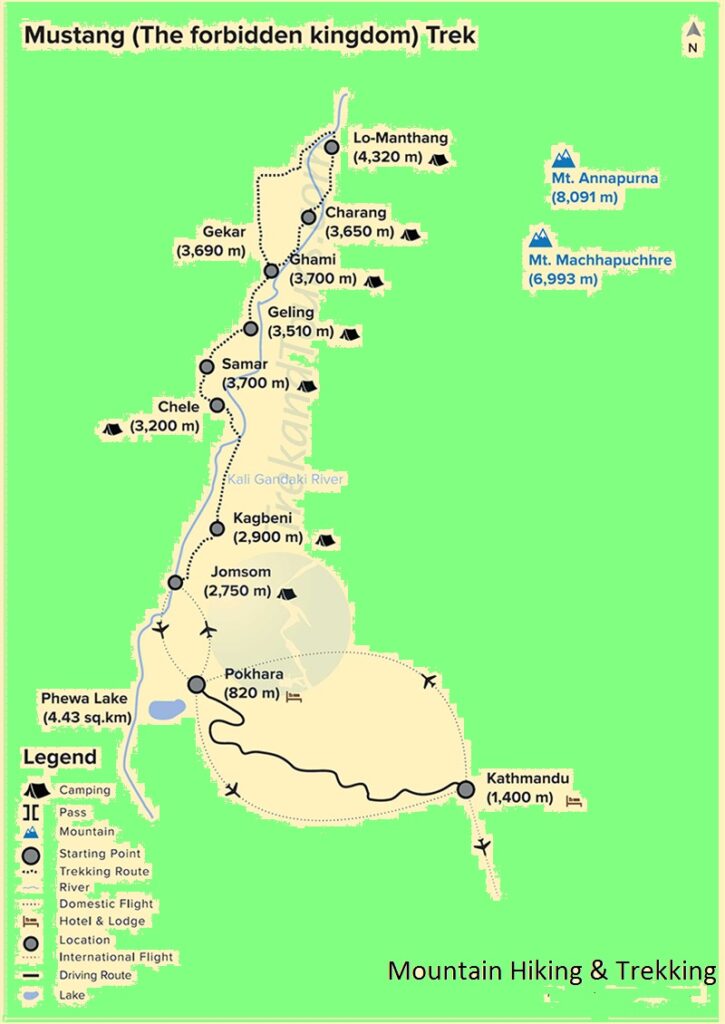
Map Location
General FAQs
Where is Mustang ?
Mustang is a remote region located in the north-central part of Nepal, bordering Tibet.
What is the duration of the Mustang trek?
The duration of the Mustang trek can range from 10 to 14 days, depending on the itinerary and route selected.
When is the best time to do the Mustang trek?
The best time to do the Mustang trek is during the months of March to May and September to November. These months offer favorable weather conditions with clear skies and mild temperatures.
What is the altitude of the Mustang trek?
The highest altitude of the Mustang trek is at the Lo La Pass, which is at an elevation of 3,950 meters (12,960 feet).
What is the level of difficulty of the Mustang trek?
The Mustang trek is considered a moderate trek with some strenuous sections. The trek involves steep climbs and descents, so it is recommended to have some prior trekking experience and a good level of fitness.
What permits are required for the Mustang trek?
A special trekking permit called the Upper Mustang Restricted Area Permit is required for the Mustang trek. It is issued by the Department of Immigration in Kathmandu and costs around USD 500 for 10 days.
What is the accommodation like during the Mustang trek?
Accommodation during the Mustang trek is basic and typically consists of teahouses or lodges. The facilities are simple and may not include amenities such as hot showers or flush toilets.
What are the highlights of the Mustang trek?
The Mustang trek is known for its stunning mountain scenery, unique culture, and ancient monasteries. The highlights of the trek include the ancient walled city of Lo Manthang, the Kali Gandaki Gorge, and views of the Annapurna and Dhaulagiri mountain ranges.
What should I pack for the Mustang trek?
It is recommended to pack warm clothing for cold evenings, comfortable hiking boots, a daypack, a sleeping bag, a first aid kit, and other trekking essentials. It is also important to pack for the high-altitude environment and to be prepared for changing weather conditions.rnrn
Is it safe to do the Mustang trek?
Yes, the Mustang trek is generally considered safe. However, it is important to take necessary precautions to prevent altitude sickness and to trek with a licensed guide and porter for added safety and support.
How do I prepare for the high altitude on the EBC trek?
Acclimatization is key to preventing altitude sickness. It's important to ascend slowly, stay hydrated, and take acclimatization days. Some trekkers use medication like Diamox, but consult your doctor before the trek.